CBSE Syllabus: What’s Included and How to Use It for Better Exam Prep
When you’re studying for school exams in India, the CBSE syllabus, the official curriculum set by the Central Board of Secondary Education for schools across India. Also known as the CBSE curriculum, it tells you exactly what topics you need to learn for classes 1 through 12—and what won’t be on the test. It’s not just a list of chapters. It’s your roadmap. If you skip something because you think it’s "not important," you might be wrong. CBSE doesn’t test everything equally. Some topics carry 5 marks, others 10. Some appear every year. Others show up once every three cycles.
The CBSE class 10, the final year of secondary education under CBSE, with board exams that determine stream selection for higher studies and CBSE class 12, the higher secondary level where students choose science, commerce, or arts streams for university admission syllabi are the most critical. They don’t just cover content—they define the exam pattern. For example, in class 10 Science, 20% of marks come from practicals. In class 12 Maths, 30% is based on application-based questions. If you only memorize formulas and ignore problem-solving practice, you’re playing with fire. The board changed the pattern in 2020 to reduce rote learning. Now, they ask you to analyze, connect ideas, and explain real-life uses. That’s why past papers matter so much—they show you how the syllabus turns into actual questions.
Teachers and coaching centers often add extra topics, but the only thing that counts is what’s in the official CBSE syllabus document. You’ll find it on cbseacademic.nic.in. It breaks down each subject by unit, weightage, and learning outcomes. For example, in English, the syllabus specifies how many marks go to reading, writing, grammar, and literature. In Social Science, it tells you exactly which chapters from History, Geography, Political Science, and Economics are included. There’s no room for guesswork. And if your school gives you a different list, compare it with the official one. You’ll often find they’ve added outdated or irrelevant material.
The CBSE exam pattern, the structure of question papers including mark distribution, question types, and time allocation is designed to be fair but strict. You can’t rely on luck. You need to know the weightage of each chapter. You need to know how many short-answer questions come from which unit. You need to know if the board favors diagram-based answers in Biology or step-wise solutions in Physics. That’s why students who stick to the syllabus and practice with sample papers do better than those who cram from random sources. The board doesn’t change the syllabus every year—but when it does, it’s a big deal. In 2023, they removed a few chapters from Class 12 Physics to reduce load. In 2021, they added new case-study questions in Economics. You can’t afford to use old books without checking the latest update.
What you’ll find below are real posts from students and teachers who’ve been there. They break down what’s actually tested, how to prioritize topics, what to skip, and how to turn the syllabus into a study plan that works. No fluff. No theory. Just what helps you score higher without burning out.

Which Degree Is the Toughest in India? CBSE Students Reveal the Real Challenge
- Myles Farfield
- 0 Comments
The toughest degrees in India-engineering, medicine, and Chartered Accountancy-demand extreme endurance, not just intelligence. CBSE students face intense pressure to excel, but the real challenge begins after the exams.
Read more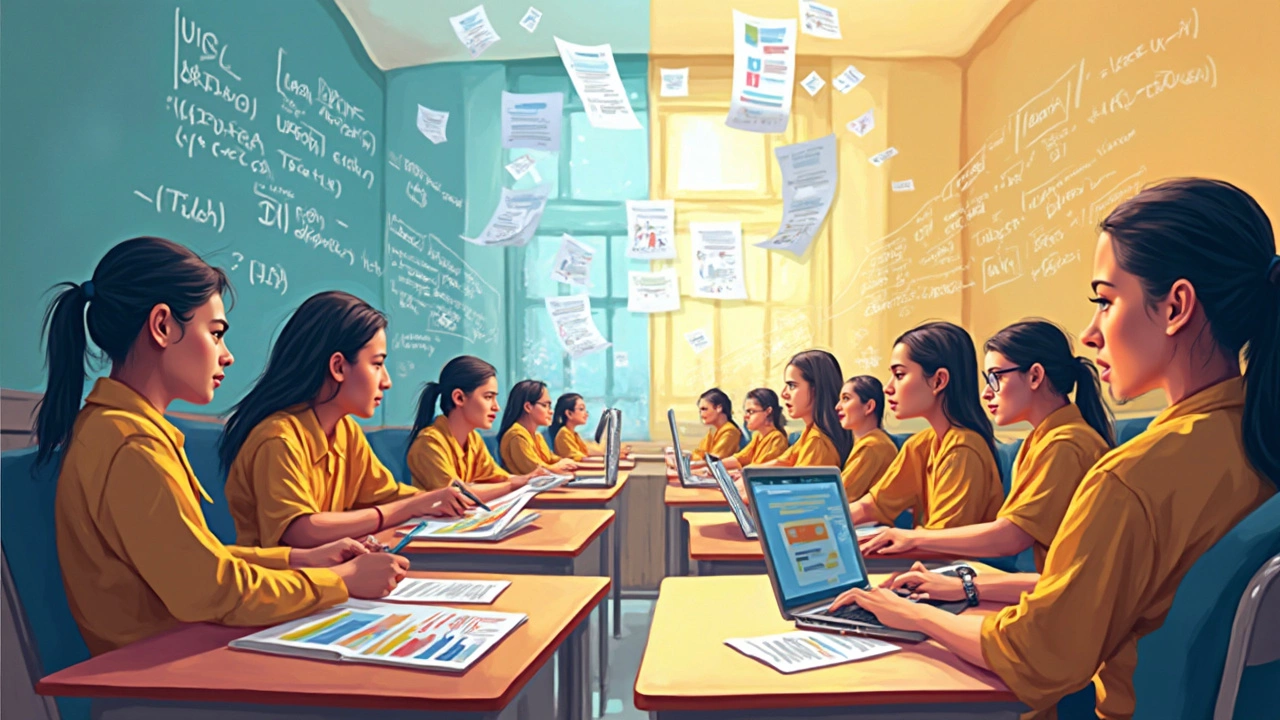
Are UK or USA Exams Easier? CBSE Syllabus Guide
- Myles Farfield
- 0 Comments
Wondering if exams are easier in the UK or USA? This article breaks down how both countries design, structure, and grade their school tests, especially through the lens of the CBSE syllabus. You'll get a clear comparison, real-life tips, and some little-known facts about study pressure, test types, and exam tactics. Find out what makes each system tick—and how students feel the crunch. Plus, get practical advice if you’re planning to switch between systems.
Read more
Does Harvard Accept CBSE? What Indian Students Need to Know
- Myles Farfield
- 0 Comments
Curious if Harvard accepts the CBSE board for admissions? Here's what Indian students from a CBSE background should know, including Harvard’s view on Indian syllabi, application tips, extra requirements, and real-life stories. This guide breaks down the facts, ditches the jargon, and tells you how to boost your chances if Harvard is your dream. Learn which documents to gather, how your grades translate, and the steps to stand out.
Read more
Is Delhi Public School ICSE or CBSE? Understanding Its Curriculum
- Myles Farfield
- 0 Comments
Delhi Public School, a popular choice among parents in India, offers a curriculum under the Central Board of Secondary Education (CBSE). It's essential to understand the differences between CBSE and ICSE to make informed decisions about school enrollments. Parents often seek CBSE for its nationalized approach and streamlined syllabus, while ICSE offers a wide-ranging curriculum. Knowing the specific board affiliation can help better prepare students for future academic endeavors.
Read more
Navigating the Best Educational Board for Children's Future Success
- Myles Farfield
- 0 Comments
Choosing the right educational board can significantly impact a child's future. With options like CBSE, parents must weigh factors such as curriculum structure, available resources, and future opportunities. By understanding these elements, caregivers can make informed decisions that align with their child's needs and aspirations. This article explores critical considerations and offers guidance for selecting an educational path that fosters growth and achievement.
Read more