
Free Coding Path Selector
Not sure where to start? Answer these three questions to find the best free platform for your specific needs.
Here is the uncomfortable truth: you absolutely can learn to code online for free. In fact, some of the best developers working at companies like Google or Facebook are entirely self-taught. But there is a catch that most "top 10 free resources" lists gloss over. It isn't about finding the right website; it's about surviving the boredom, the confusion, and the urge to quit when nothing works for three hours straight.
If you are in Auckland or anywhere else with a stable internet connection, the barrier to entry has never been lower. You don't need a degree. You don't need expensive hardware. You just need a laptop, patience, and a strategy. This guide cuts through the noise to show you exactly how to go from zero to writing your first real application without spending a cent.
The Reality Check: What "Free" Actually Means
When we say "free," we mean no monetary cost. That’s obvious. But what people often forget is the time investment. A university computer science degree takes four years and costs tens of thousands of dollars. Self-teaching via free online resources might take six months to two years, depending on your pace. The trade-off is flexibility versus structure.
Most beginners fail not because the material is too hard, but because they lack a roadmap. They jump from one tutorial to another, building small widgets that break as soon as they try to scale them up. To succeed, you need to treat these free resources like a curriculum, not a buffet. Pick a path, stick to it, and ignore everything else until you’ve finished it.
Where to Start: The Big Three Platforms
Not all free platforms are created equal. Some are video-heavy and passive; others are interactive and rigorous. Here are the three heavy hitters that consistently produce job-ready skills.
freeCodeCamp is arguably the most comprehensive free resource available today. It is a non-profit organization that offers a structured curriculum covering web development, data visualization, and backend APIs. Unlike passive video sites, freeCodeCamp requires you to write code in the browser to pass each module. You earn certifications by completing projects, which gives you a tangible portfolio piece. It’s tough, repetitive, and effective.
CS50x from Harvard University, hosted on edX, is the gold standard for understanding computer science fundamentals. Taught by David J. Malan, this course is intense. It doesn’t just teach you Python or C; it teaches you how computers think. If you want to understand memory management, algorithms, and data structures, this is the place. It’s harder than typical bootcamps, but if you finish it, you’ll be ahead of many paid graduates.
The Odin Project is a community-driven open-source curriculum. It assumes you know nothing and guides you through setting up your own local environment (Linux/Mac/Windows), using Git, and building full-stack applications. It avoids the "hand-holding" trap of other platforms. Instead of giving you snippets, it forces you to read documentation and solve problems. It’s perfect if you want to simulate the actual experience of being a junior developer.
| Platform | Best For | Learning Style | Certification | Difficulty |
|---|---|---|---|---|
| freeCodeCamp | Web Dev (HTML/CSS/JS) | Interactive Browser Coding | Yes (Project-based) | Moderate |
| CS50x (Harvard) | Computer Science Fundamentals | Lectures + Problem Sets | Yes (Paid option for verified cert) | Hard |
| The Odin Project | Full-Stack Development | Self-Paced Local Environment | No (Portfolio focus) | Moderate-Hard |
| Khan Academy | Absolute Beginners/Kids | Video + Simple Exercises | No | Easy |
| MIT OpenCourseWare | Deep Theory/Math Heavy | Lecture Notes + Assignments | No | Very Hard |
Picking Your First Language
You might be tempted to start with Python because everyone says it’s easy. And they’re right-its syntax reads like English. However, if your goal is to get hired quickly as a junior developer, JavaScript is often the better starting point. Why? Because every modern website uses it. Learning JavaScript allows you to build visual things immediately, which keeps motivation high.
Here is a simple decision tree:
- Want to build websites? Start with HTML, CSS, then JavaScript. Follow freeCodeCamp’s Responsive Web Design certification.
- Interested in Data Science/AI? Start with Python. Take CS50P (Python-specific version) or use Kaggle’s free micro-courses.
- Want to understand how computers work? Start with C via CS50x. It’s painful but rewarding.
Don’t switch languages halfway through. Sticking with one language for at least three months builds muscle memory. Switching confuses your brain and resets your progress.
The Hidden Cost: Setting Up Your Environment
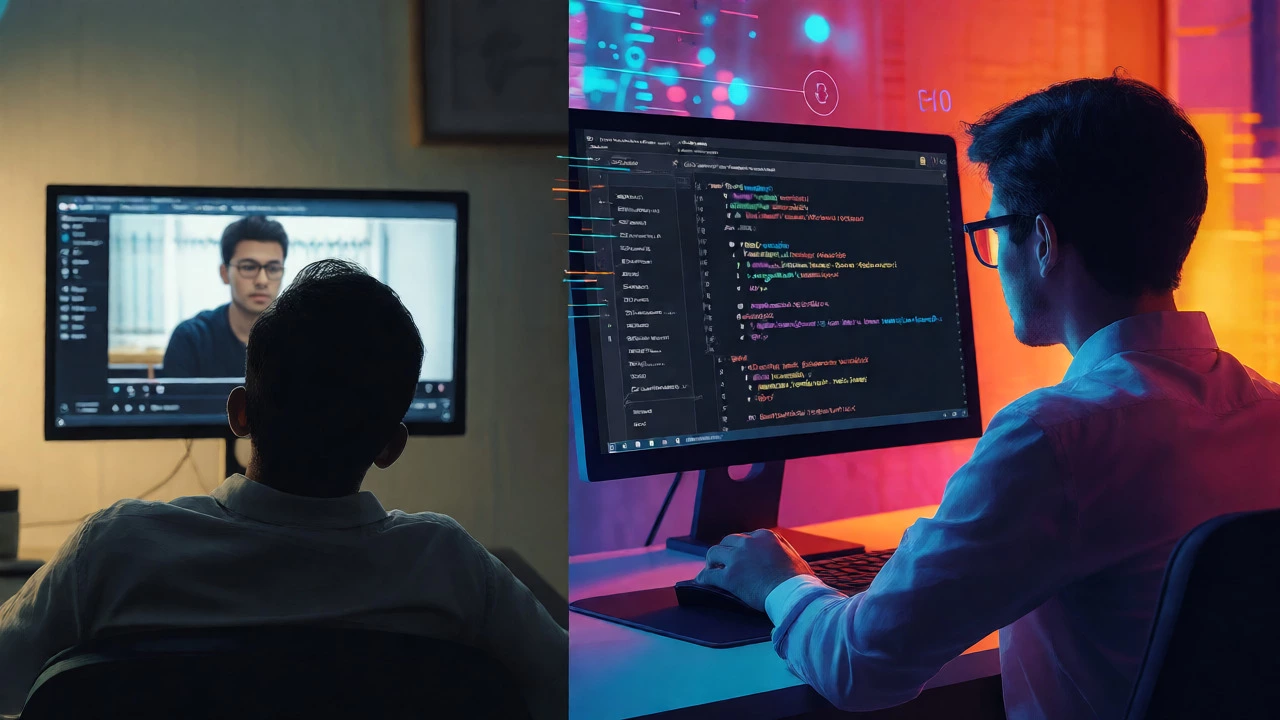
Many free tutorials run code in the browser. This is great for learning syntax but terrible for real-world practice. Professional developers don’t code in a browser tab; they use an Integrated Development Environment (IDE). You need to learn how to install tools on your computer.
Start by downloading Visual Studio Code. It’s free, lightweight, and supported by Microsoft. Next, learn Git. Git is a version control system that saves your work history. It sounds technical, but it’s essential. If you break your code, Git lets you undo mistakes instantly. GitHub is where you store those files online. Creating a GitHub profile early means you have a place to showcase your projects to employers later.
Expect friction here. Installing Node.js, configuring paths, and fixing errors will take longer than writing the actual code. This is normal. Every developer goes through this phase. Don’t let it discourage you.
Building Projects vs. Watching Tutorials
This is where most self-learners stall. They watch ten hours of YouTube videos and feel productive. But watching someone else code is like watching someone else lift weights-you don’t get stronger. You must type the code yourself.
Follow the 70/30 rule: spend 30% of your time learning new concepts and 70% building projects. When you finish a tutorial, close the window and try to rebuild the project from scratch without looking at the solution. If you get stuck, look at the docs, not the video.
Good starter projects include:
- A personal portfolio site (HTML/CSS).
- A to-do list app that saves tasks to local storage (JavaScript).
- A weather app that fetches data from a public API (Fetch API).
- A simple blog engine using a database (SQL or MongoDB).
These projects prove you can handle data, user input, and external services. They are far more impressive to hiring managers than a certificate alone.

How to Stay Motivated Without a Teacher
There is no professor emailing you if you miss a week. No classmates waiting for you in the library. Isolation is the biggest killer of self-taught coders. You need to create artificial accountability.
Join communities. Reddit’s r/learnprogramming, Discord servers like The Programmer’s Hangout, or local meetups in cities like Auckland or Wellington can help. Post your progress daily. Even if it’s just "I fixed a bug," posting publicly creates social pressure to keep going.
Also, embrace the struggle. Feeling stupid is part of the process. If you aren’t confused, you aren’t learning. When you hit a wall, step away. Go for a walk. Sleep on it. Your brain processes logic problems while you rest. Many bugs are solved in the shower, not at the desk.
From Student to Job Seeker
Once you’ve built three solid projects and understand the basics, you’re ready to apply for internships or junior roles. Update your LinkedIn profile. Highlight your projects with links to live demos and GitHub repositories. Don’t claim expertise you don’t have. Say "Familiar with JavaScript" rather than "Expert."
Prepare for technical interviews. These usually involve solving algorithmic problems on a whiteboard or shared screen. Practice on LeetCode (the free tier is sufficient for starters). Focus on arrays, strings, and hash maps. You don’t need to memorize complex dynamic programming yet. Just show that you can think logically and communicate your thought process.
Remember, the tech industry values proof of skill over pedigree. If you can demonstrate that you built a working application, debugged it, and deployed it, you are qualified. The free route is harder because you have to manage your own discipline, but it is entirely viable.
Is it realistic to get a job after learning only from free online resources?
Yes, it is realistic, but it requires persistence. Employers care about your portfolio and ability to solve problems, not necessarily where you learned. Many successful developers are self-taught. However, you may face initial bias against candidates without degrees, so having strong, deployed projects is crucial to overcome this hurdle.
Which free platform is best for absolute beginners?
For absolute beginners who find coding intimidating, Khan Academy or Codecademy’s free tier are good starting points because they offer immediate visual feedback. However, for a more career-focused path, freeCodeCamp is recommended due to its structured curriculum and project requirements, despite being slightly more demanding.
Do I need to pay for any certificates?
Generally, no. While platforms like Coursera or edX charge for verified certificates, the knowledge itself is free. In the tech industry, a GitHub repository with well-documented code is often valued higher than a generic completion certificate. Save your money for hardware or cloud hosting costs instead.
How long does it take to become employable?
If you study consistently for 15-20 hours a week, expect 6 to 9 months to reach a junior-level competency. This includes time for building projects and preparing for interviews. Rushing this process often leads to gaps in knowledge that become apparent during technical interviews.
Should I learn Python or JavaScript first?
Choose based on your goal. Choose JavaScript if you want to build websites and see visual results quickly. Choose Python if you are interested in data science, automation, or backend logic without the complexity of DOM manipulation. Both are excellent choices with massive job markets.
