Coding Career Math Calculator
Select your primary interests and goals to find the coding path that fits your comfort level with math.
Recommended Path
Key Skills Needed:
- • HTML & CSS
- • JavaScript Logic
- • UI/UX Principles
Select your preferences and click "Find My Path" to see if you need math for your dream job.
You sit down at your computer, ready to start that online course you’ve been eyeing. But then the doubt creeps in. You remember high school algebra with a mix of dread and confusion. You think, "If I couldn't even balance an equation back then, how am I supposed to write code?" It’s a question that stops thousands of people from ever hitting "enroll."
Here is the short answer: Yes, you can absolutely learn to code if you are bad at math. In fact, most professional developers rarely use anything more complex than basic arithmetic in their daily work.
The idea that programming requires a brain wired for calculus is one of the biggest myths in tech. It keeps talented people out of the industry simply because they believe a lie. Let’s break down why this myth exists, what kind of logic you actually need, and which paths in technology will let you build amazing things without ever touching a quadratic formula.
The Myth of the Math-Heavy Coder
Where does this fear come from? A lot of it stems from computer science degrees. University programs often require heavy math courses like linear algebra, discrete mathematics, and statistics. These subjects are taught because they help you understand the theoretical underpinnings of algorithms and data structures. They teach you how computers process information at a fundamental level.
But there is a massive difference between Computer Science is the academic study of computation, automation, and information and Software Development is the practical process of designing, coding, testing, and maintaining applications. One is theory; the other is practice.
Think of it like becoming a chef. Do you need to understand the chemical composition of every ingredient to make a delicious meal? No. You need to know how flavors combine, how heat affects texture, and how to follow or create a recipe. Similarly, most coding jobs are about solving practical problems, not proving mathematical theorems. Unless you plan to work on AI research, cryptography, or video game physics engines, advanced math is largely irrelevant to your day-to-day tasks.
Logic vs. Arithmetic: What Coding Actually Requires
If you aren’t doing calculus, what are you doing? You’re using logic. And here is the good news: logic is not the same as math. Logic is just common sense structured in a specific way.
Coding is essentially giving instructions to a machine. You tell the computer: "If this happens, do that. Otherwise, do this." This is called conditional logic. It’s something you use every day without realizing it.
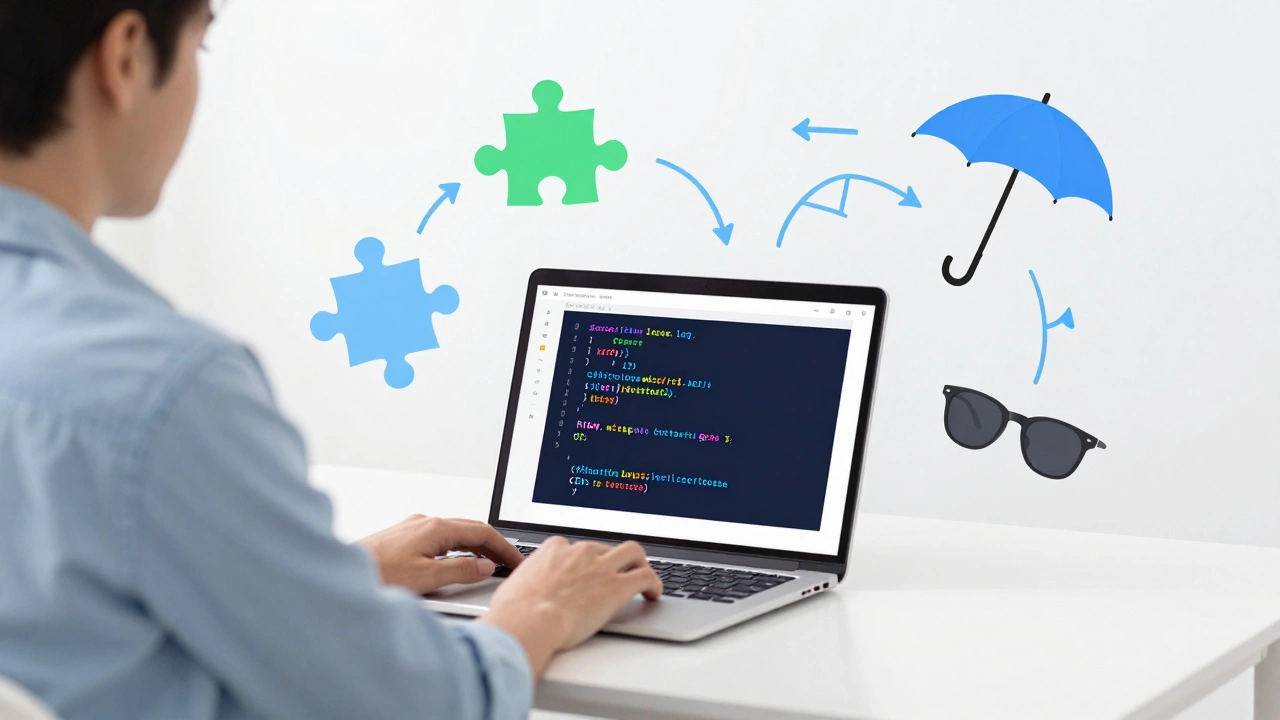
- Everyday Logic: "If it rains, I will take an umbrella. Otherwise, I will wear sunglasses."
- Coding Logic: "If user clicks button, show popup. Else, hide menu."
This type of thinking is intuitive. It doesn’t require memorizing formulas. It requires breaking a big problem into small, manageable steps. This skill is called decomposition. When you bake a cake, you decompose the process into mixing ingredients, preheating the oven, and baking. When you code, you decompose a website feature into fetching data, displaying text, and handling errors.
Another key concept is pattern recognition. You look at a situation, identify what has changed, and apply a rule. For example, if you notice that every time a user logs in, the screen refreshes, you might want to prevent that refresh. You spot the pattern (login triggers refresh) and write a rule to stop it. That’s it. That’s programming.
Which Coding Paths Require Little to No Math?
Not all coding fields are created equal. Some areas lean heavily into numbers, while others focus entirely on design, structure, and content. If you want to avoid math, choose your path wisely.
| Coding Path | Primary Focus | Math Level Needed | Best For |
|---|---|---|---|
| Frontend Web Development | User interface, layout, visual design | Basic arithmetic (adding pixels) | Creative thinkers, designers |
| WordPress/CMS Development | Content management, site customization | None | Small business owners, bloggers |
| QA Testing | Finding bugs, verifying features | Logical reasoning only | Detail-oriented individuals |
| Data Analysis | Interpreting datasets, trends | Statistics, Excel-level math | Researchers, marketers |
| Machine Learning/AI | Predictive modeling, neural networks | Calculus, Linear Algebra, Stats | Math enthusiasts, scientists |
Frontend Web Development is the safest bet for math-phobes. You’ll be working with HTML, CSS, and JavaScript. Your main concern is whether a button looks centered on the screen or if the font size is readable. The math involved is usually adding up pixel widths to ensure a layout fits. If you can add 100 + 200, you have enough math skills for frontend development.
Backend Development involves server-side logic. While it uses more logic, it still rarely requires advanced math. You might calculate tax percentages or discount rates, but these are simple multiplications. The complexity comes from managing data flow and security, not from equations.
Real-World Examples: What Developers Actually Do
To put your mind at ease, let’s look at what a typical day looks like for a developer who isn’t a math wizard.
Sarah is a junior web developer. Her task for the morning is to fix a bug where the contact form on her company’s website isn’t sending emails. She doesn’t pull out a calculator. She reads the error message in the console. She checks the code that handles the email submission. She realizes she forgot to include the API key. She adds the key, tests the form, and sends the email. Done.
John is building an e-commerce store. He needs to display products in a grid of three columns. He writes CSS code that says "each product takes up 33% of the width." He doesn’t derive the percentage; he just knows that three items in a row means roughly a third each. If the layout breaks on mobile phones, he adjusts the code to show one item per column (100% width). This is basic proportion, not algebra.
These examples show that coding is mostly about reading documentation, searching for solutions online, and applying logical fixes. Stack Overflow, GitHub, and official documentation are your best friends, not textbooks.
How to Start Learning Without Fear
So, how do you begin? The key is to pick resources that focus on practical application rather than theoretical computer science.
- Choose Visual Languages: Start with HTML and CSS. You see immediate results. You change a color, and the page changes. This positive reinforcement builds confidence.
- Use Interactive Platforms: Sites like freeCodeCamp, Codecademy, or The Odin Project guide you step-by-step. They don’t ask you to solve equations; they ask you to complete small coding challenges.
- Build Projects Early: Don’t wait until you “know enough.” Build a personal portfolio page. Create a simple to-do list app. Real projects force you to learn what you need, when you need it.
- Avoid Academic Textbooks: Stay away from books titled "Introduction to Algorithms" or "Discrete Mathematics for Computer Science." Stick to "Head First JavaScript" or "Eloquent JavaScript," which explain concepts through analogy and example.
Remember, frustration is part of the process. Getting stuck on a syntax error (like missing a semicolon) is normal. It doesn’t mean you’re bad at math; it means you’re learning a new language. Patience and persistence matter far more than IQ or math grades.

When Does Math Actually Matter?
It’s important to be honest about where math becomes necessary. If you decide later in your career that you want to pivot into specialized fields, you may need to brush up on your skills. These fields include:
- Game Development: Physics engines require vector math and trigonometry to simulate gravity, collisions, and movement.
- Graphics Programming: Creating 3D visuals involves linear algebra to manipulate shapes in space.
- Cryptography: Securing data relies heavily on number theory and prime numbers.
- Quantitative Finance: Trading algorithms use statistical models to predict market movements.
However, these are niche areas. The vast majority of software jobs-building websites, apps, internal tools, and databases-do not require this level of mathematical depth. You can have a highly successful, lucrative career in tech without ever worrying about integrals.
Mindset Shift: From Calculator to Problem Solver
The biggest hurdle isn’t intellectual; it’s psychological. Many people who say they are "bad at math" are actually just anxious about being wrong. Coding is full of mistakes. Errors are not failures; they are feedback. The computer tells you exactly what went wrong and where. It’s a safe environment to experiment.
Shift your mindset from "I need to get the right answer" to "I need to figure out why this didn’t work." This curiosity-driven approach is the heart of programming. You don’t need to know everything upfront. You just need to be willing to look things up and try again.
Consider this: The internet exists because people decided to connect computers. Social media exists because people wanted to share photos. These platforms were built by humans who started exactly where you are now-with no idea how to code. They learned by doing. They failed, they fixed, and they improved.
Your Next Steps
If you’re ready to take the leap, here is a simple plan for your first month:
- Week 1: Learn HTML basics. Build a simple page with a heading, paragraph, and image.
- Week 2: Add CSS. Change the colors, fonts, and layout. Make it look nice.
- Week 3: Introduce JavaScript. Make a button that changes the background color when clicked.
- Week 4: Build a small project. A personal bio page or a favorite recipes list.
By the end of four weeks, you will have tangible proof that you can create something digital. That confidence will outweigh any lingering fears about math. Remember, coding is a skill like playing guitar or cooking. It takes practice, not a PhD in mathematics.
Don’t let a past grade in high school algebra define your future career. The tech world needs diverse thinkers, creative problem solvers, and people who can communicate clearly. If you can think logically and are willing to learn, you belong in coding. Start today, and prove the doubters-including yourself-wrong.
Do I need to know algebra to learn Python?
No, you do not need algebra to learn Python. Python is a high-level language designed to be readable and easy to use. Most Python tasks involve manipulating text, managing lists of data, or automating repetitive tasks. While you might use basic addition or subtraction, algebraic equations are rarely required unless you are doing scientific computing or data analysis.
Is coding harder than math?
For many people, yes. Math often requires abstract thinking and strict rules with one correct answer. Coding is more flexible. There are multiple ways to solve a problem, and the feedback loop is immediate. If your code doesn't work, you get an error message that helps you debug. This iterative process can feel less intimidating than staring at a blank paper during a math test.
What is the easiest programming language for someone bad at math?
HTML and CSS are the easiest starting points because they are not programming languages in the traditional sense; they are markup and style languages. They require zero math. After that, JavaScript is a great choice because it is used everywhere on the web and focuses on logic and interaction rather than numerical calculation.
Can I become a software engineer without a CS degree?
Absolutely. Many successful software engineers are self-taught or attended coding bootcamps. Employers care more about your ability to build solutions and solve problems than your academic background. A strong portfolio of projects demonstrates your skills better than a degree that focused heavily on theory.
Does being bad at math affect my salary potential in tech?
Not necessarily. Salaries in tech vary widely based on role, experience, and location. Frontend developers, UX engineers, and DevOps specialists often earn competitive salaries without needing advanced math skills. Specialized roles in AI or quantitative finance may pay more but require those specific mathematical competencies. However, the average software engineering salary is well above the national median regardless of math proficiency.
