
Is an MBA worth it? That’s the question every mid-career professional asks when they see the price tag: $80,000, $120,000, even $180,000 for top programs. And that’s just tuition. Add living costs, lost income, and travel expenses, and you’re looking at a quarter of a million dollars poured into a two-year program. But here’s the thing-some people get back three times that in salary bumps, promotions, and new opportunities. Others walk away with debt and no clear path forward. So what actually makes an MBA worth it in 2026?
Who benefits most from an MBA?
The MBA doesn’t work the same way for everyone. If you’re a software engineer with five years of experience and you want to move into product management, an MBA from a mid-tier school might be the fastest way to make that shift. You’ll learn how to talk to marketing teams, manage budgets, and lead cross-functional projects-all skills your technical background doesn’t cover.
But if you’re a nurse or a teacher looking to climb into healthcare administration or school district leadership, an MBA might be overkill. Many of those roles value domain expertise more than business theory. In fact, a Master’s in Health Administration or Educational Leadership often leads to higher pay and faster promotion than a general MBA.
The real sweet spot? People who are already in business roles but stuck at the manager level. Sales reps who want to run a region. Operations coordinators aiming for plant manager. Finance analysts targeting controller roles. These are the people who see the MBA as a bridge-not a detour.
What’s the real cost in 2026?
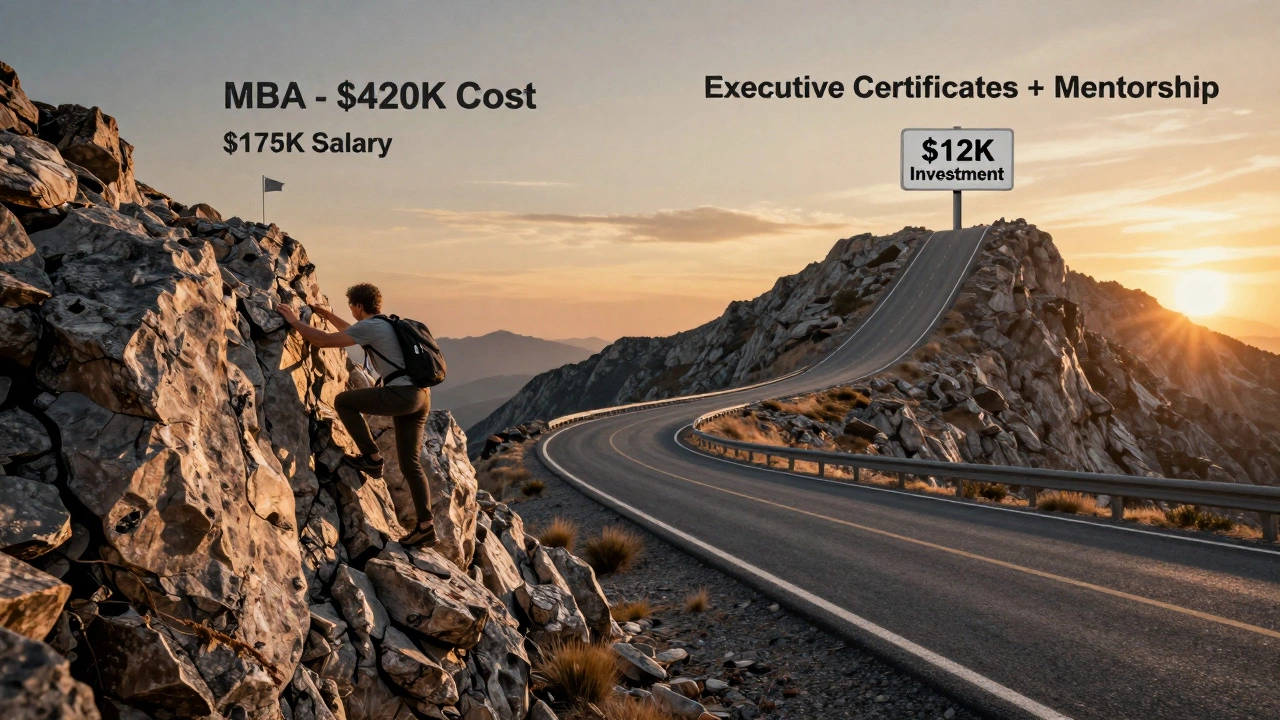
Let’s break it down with numbers that match today’s reality. A two-year MBA at a top U.S. school like Harvard or Stanford costs around $180,000 in tuition alone. Add $35,000 a year for housing, food, books, and incidentals, and you’re at $250,000 total. That’s before you factor in the salary you’re giving up. If you were earning $85,000 a year before school, you’re losing $170,000 in income over two years. Total out-of-pocket cost? Close to $420,000.
Now look at a public U.S. school like Indiana University’s Kelley School or a Canadian school like Rotman. Tuition drops to $60,000-$80,000. Living costs? Maybe $25,000 a year. Lost income? Still $170,000. Total? Around $280,000. Still steep-but a lot more manageable.
And what about Europe or Asia? INSEAD in France or Singapore? One-year programs. Tuition: $90,000-$110,000. Lost income: $85,000. Total: under $200,000. That’s half the cost of a top U.S. program-and many graduates land jobs at the same companies.
What do MBA grads actually earn in 2026?
Paychecks after graduation tell the real story. According to the 2025 Graduate Management Admission Council survey, the median starting salary for MBA grads in the U.S. is $135,000. But that number hides huge differences. Graduates from the top 10 schools average $175,000. Those from schools ranked 50-100? Around $95,000.
And salary isn’t the only metric. Bonuses matter too. Top programs report average signing bonuses of $30,000-$40,000. Consulting and finance roles often pay more. Tech companies? They’re offering equity packages worth $20,000-$50,000 on top of base salary.
But here’s the catch: those numbers assume you land a job. About 15% of grads from non-top-tier schools struggle to find roles in their target industry. Some end up in roles that don’t use their MBA at all. That’s why school reputation, career services, and alumni networks aren’t just marketing fluff-they’re survival tools.
What’s the ROI timeline?
Let’s say you spent $280,000 on your MBA. You land a job paying $135,000. Before school, you made $85,000. Your salary bump is $50,000 a year. After taxes, you’re looking at maybe $35,000 extra in take-home pay. That means it takes about eight years to break even on your investment.
But wait-what if you get promoted faster? If your MBA helps you jump from manager to director in three years instead of six, your earnings curve changes. You might earn $160,000 by year four, $190,000 by year six. That cuts your payback period to under five years.
And if you move into a role with profit-sharing, stock options, or global assignments? The long-term payoff can be massive. One former student from Auckland I spoke with used her MBA to land a regional leadership role at Unilever in Singapore. Her salary tripled in five years. She paid off her loans in three. Now she’s managing a $200 million portfolio.
When an MBA doesn’t pay off
It’s not just about the cost. It’s about fit. I’ve seen too many people enroll because they felt pressured-‘everyone else is doing it,’ or ‘it’s the next step.’ That’s a recipe for regret.
Here are the three biggest red flags:
- You’re trying to escape your current job, not build your career.
- You don’t have a clear target role after graduation-‘business’ isn’t a job title.
- You’re choosing a school based on prestige alone, not job placement data.
One client from Wellington spent $140,000 on an MBA from a school with a 40% job placement rate in his industry. He graduated into a market saturated with MBAs. He ended up taking a job in retail management. He’s still paying off loans five years later.
The MBA isn’t a magic wand. It’s a tool. And like any tool, it only works if you know how to use it-and if you’re trying to fix the right problem.
Alternatives that cost less and deliver faster
You don’t need an MBA to get promoted. Here are three alternatives that are cheaper, faster, and just as effective for many people:
- Specialized master’s degrees-like a Master’s in Supply Chain, Digital Marketing, or Data Analytics. These cost $30,000-$60,000 and take 12-18 months. Many are online. And they’re often preferred by tech and logistics firms over general MBAs.
- Executive education programs-Harvard, MIT, and INSEAD offer six- to twelve-week certificates in leadership, strategy, or finance. Cost: $10,000-$25,000. Time: one month. Impact: immediate. Many companies pay for these.
- Internal mobility + mentorship-Talk to your HR department. Ask to lead a cross-functional project. Find a senior leader who’ll sponsor you. Many companies promote high-potential employees without requiring advanced degrees.
One engineer I know took a $12,000 data analytics certificate from Coursera, led a process improvement project that saved his company $2 million, and got promoted to team lead within a year. No MBA. No debt. Just results.

How to decide if an MBA is right for you
Here’s a simple checklist to help you decide:
- Do you have a specific job target in mind? (Not ‘business,’ not ‘leadership’-a real title like ‘Product Manager at Microsoft’ or ‘Regional Sales Director at Pfizer’)
- Does that job typically require an MBA? (Check LinkedIn profiles of people in that role)
- Can you afford the total cost-including lost income-without going into deep debt?
- Does your target school have a strong track record placing grads in your desired industry?
- Are there cheaper, faster ways to get the same skills and credentials?
If you answered ‘yes’ to the first two and ‘no’ to the last two, then yes-an MBA might be worth it.
If you’re unsure about any of those? Pause. Talk to someone who’s done it. Look at alumni LinkedIn profiles. Ask for salary data. Don’t make this decision on brochures or Instagram ads.
Final thought: It’s not about the degree. It’s about the leverage.
An MBA isn’t valuable because it’s a piece of paper. It’s valuable because it opens doors to networks, opportunities, and credibility you wouldn’t have otherwise. But if you’re already in a company that promotes based on performance-not degrees-you might not need it at all.
The people who get the best ROI aren’t the ones who spent the most. They’re the ones who used the MBA as a lever-not a life raft. They knew exactly what they wanted. They picked the right school. And they went in with a plan.
Is an MBA worth it if I’m already in a leadership role?
It depends. If you’re aiming for C-suite roles in large corporations, especially in finance, consulting, or global operations, an MBA can help you gain credibility and access to executive networks. But if you’re already leading teams successfully and your company promotes based on results, you may not need it. Many executives reach the top without an MBA by taking targeted executive courses or leading high-impact projects.
Can I get an MBA online and still get good job offers?
Yes-but not from just any online program. Top schools like UNC Kenan-Flagler, Indiana Kelley, and USC Marshall offer accredited online MBAs with the same faculty, career services, and recruiting access as their on-campus programs. Graduates from these programs land roles at Amazon, Deloitte, and PwC. But beware of low-tier online MBAs with no alumni network or employer recognition-they won’t move the needle.
How long does it take to break even on an MBA?
On average, it takes 5-8 years to recover the total cost of an MBA, including lost income and tuition. Graduates from top-tier schools often break even in 3-5 years due to higher starting salaries and faster promotions. Those from mid-tier schools may take 7-10 years, especially if they take on significant debt. The key is maximizing your post-MBA salary growth, not just the starting number.
Are international MBAs worth it for someone from New Zealand?
Yes-if you’re targeting global companies or planning to work overseas. Programs in Europe (like INSEAD, London Business School) and Asia (like NUS, HKUST) are highly respected and often cost less than U.S. programs. Many offer one-year options, reducing lost income. For Kiwis looking to work in Asia, Australia, or Europe, an international MBA can open doors that a local degree can’t. But if you plan to stay in New Zealand, a domestic MBA or executive program may offer better ROI.
Do employers still value MBAs in 2026?
Yes, but selectively. Top consulting firms, investment banks, and multinational corporations still prioritize MBAs from elite schools for leadership pipelines. But tech companies, startups, and SMEs increasingly value skills and experience over degrees. Many now test candidates on problem-solving, leadership projects, and case performance instead of checking for an MBA. The value of the degree is shifting from a credential to a signal of structured business training.
Next steps if you’re considering an MBA
Start by listing your top three target roles after graduation. Then find five people in those roles on LinkedIn. Message them: ‘I’m considering an MBA to get into [role]. What did your path look like? Would you recommend it?’ Most will respond.
Next, check the employment reports from your shortlisted schools. Look for placement rates in your industry, average salaries, and company names. Don’t trust marketing pages-go straight to the career services PDFs.
Finally, talk to your current employer. Ask if they’ll sponsor part of your MBA. Many companies will pay for tuition if you commit to staying for two years after graduation. That could cut your cost in half.
An MBA can be one of the best investments you ever make. But only if you treat it like a strategic move-not a default option.
