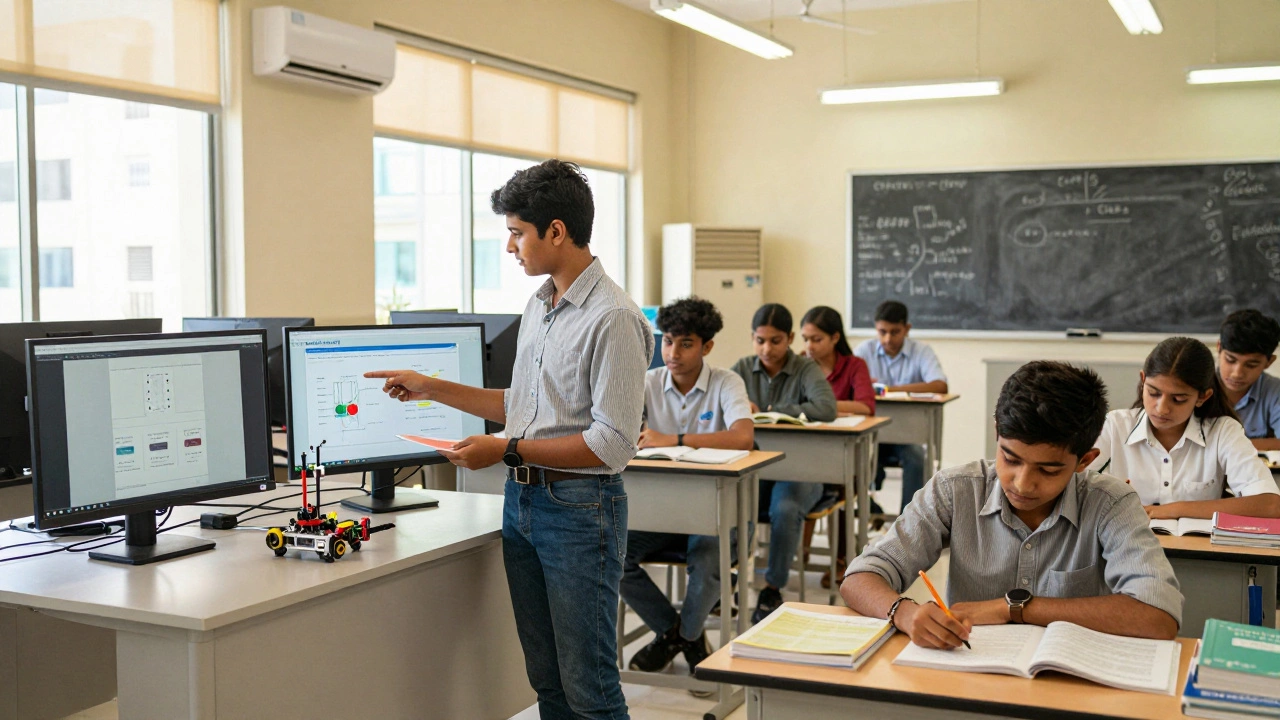
Education Path Comparison Tool
Your Child's Future Goals
Select the option that best matches your child's future career path:
Learning Style Preferences
Select how your child learns best:
Recommended Education Path
Best for students who:
- Plan to study in India (IIT, AIIMS, government jobs)
- Thrive in structured, exam-focused environments
- Prefer clear learning pathways with predictable outcomes
Alternative Option
Best for students who:
- Aim for universities outside India (US, UK, Canada)
- Learn through discussion, projects, and real-world applications
- Need global exposure and cross-cultural communication skills
When parents ask if Dubai education is better than India, they’re usually thinking about one thing: CBSE syllabus. It’s not just about which country has nicer classrooms or more English-speaking teachers. It’s about what your child will actually learn, how they’ll be tested, and whether the system prepares them for real life - not just exams.
Let’s cut through the noise. Dubai doesn’t have one education system. It has dozens. Some schools follow the Indian CBSE curriculum. Others use the British GCSE, the American Common Core, or the International Baccalaureate (IB). Meanwhile, across India, over 20 million students are on the CBSE track. So comparing "Dubai education" to "India" is like comparing apples to orange orchards.
What CBSE Actually Teaches - And Why It Matters
CBSE isn’t just a set of textbooks. It’s a tightly structured system built around national exams - especially the Class 10 and Class 12 board exams. These aren’t practice tests. They’re high-stakes gatekeepers. A student’s future in engineering, medicine, or civil services hinges on how well they perform here.
The CBSE syllabus is known for being rigorous in math and science. By Grade 10, students are solving quadratic equations, understanding electromagnetic induction, and writing detailed biology lab reports. In Grade 12, they’re tackling calculus, organic chemistry mechanisms, and complex physics problems. It’s designed to produce students who can handle competitive exams like IIT JEE and NEET.
But here’s the trade-off: CBSE leans heavily on memorization and exam technique. Critical thinking? Often secondary. Creativity? Rarely rewarded. A student who can regurgitate the steps of photosynthesis gets an A. One who asks, "Why does chlorophyll absorb red light?" might get marked down for not sticking to the textbook.
Dubai Schools: A Patchwork of Systems
Dubai’s schools are a mix. You’ve got Indian-curriculum schools (many run by CBSE-affiliated boards), British schools (Cambridge IGCSE/A-Levels), American schools (AP and SAT-focused), and IB schools. Each has a different philosophy.
Take IB, for example. It’s not about memorizing formulas. It’s about writing 4,000-word research papers, doing 150 hours of community service, and defending your science project to a panel of strangers. IB students learn to argue, analyze, and adapt. But they rarely drill quadratic equations until they can solve them blindfolded.
British curriculum schools in Dubai focus on depth over breadth. A student might spend six months on one historical period, writing essays that require evidence, context, and original thought. But their math curriculum doesn’t go as deep into calculus as CBSE does by Grade 11.
And then there are the Indian-curriculum schools in Dubai - yes, they exist. They follow the exact same CBSE syllabus, use the same NCERT books, and give the same board exams. The only difference? The classrooms are air-conditioned, and the school fees are five times higher.
Who Benefits From CBSE?
If your child plans to study in India - especially in engineering, medicine, or government services - CBSE is still the most direct path. Over 90% of IITs and AIIMS admit students based on national entrance exams that are designed around CBSE content. If you’re not on that track, you’re playing catch-up.
Take a student from a Dubai IB school who wants to get into IIT. They’ll need to relearn math topics not covered in IB, memorize biology chapters not in their curriculum, and spend months preparing for a system they’ve never experienced. It’s possible. But it’s not easy.
CBSE also gives students a clear roadmap. Year 1: Learn fractions. Year 5: Solve linear equations. Year 10: Crack the board exam. Year 12: Ace JEE. It’s predictable. For families who value structure, this is a feature - not a bug.
What Dubai Offers That CBSE Doesn’t
Dubai’s international schools - especially IB and British ones - teach something CBSE rarely does: how to think, not just what to think.
IB students in Dubai regularly engage in Theory of Knowledge (TOK) classes. They debate whether truth exists in science, how bias shapes history, and if ethics can be measured. These aren’t classroom debates. These are life skills.
British curriculum schools emphasize extended writing. A 12th-grade student might write a 3,000-word essay on the causes of World War I, using primary sources, historiography, and peer-reviewed journals. That’s not just history. That’s research training.
Dubai schools also expose students to global perspectives early. A child in a Dubai school might have classmates from 15 different countries. They learn to navigate cultural differences, speak in mixed groups, and adapt to varying communication styles - skills that matter in today’s global workforce.
And let’s not ignore resources. Dubai schools often have robotics labs, AI simulation tools, and partnerships with universities. A CBSE school in rural India might not even have a working science lab.
The Real Difference: Outcomes
Here’s what the data shows:
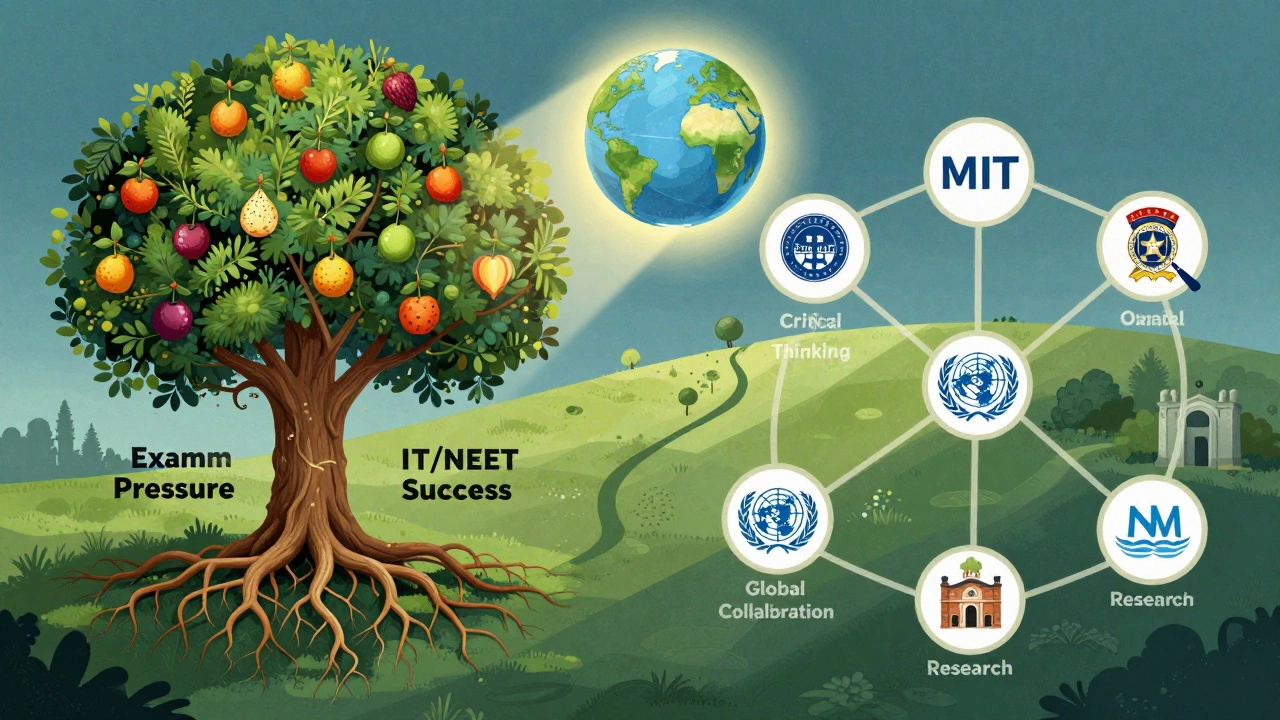
- CBSE students dominate Indian engineering and medical entrance exams - but only 15% pursue careers in research or innovation.
- IB students from Dubai have a 30% higher rate of admission to top global universities like MIT, Oxford, and ETH Zurich.
- Over 60% of IB graduates report feeling "well-prepared for university-level critical thinking" - compared to 22% of CBSE graduates.
But here’s the twist: IB graduates are less likely to join India’s public sector jobs or crack UPSC exams. They often go global - to tech startups in Berlin, NGOs in Kenya, or grad school in Canada.
So the question isn’t "Which is better?" It’s "Better for what?"
Who Should Stick With CBSE?
- Parents planning for IIT, AIIMS, or government jobs in India
- Families who value structure, clear goals, and a proven path
- Students who thrive in competitive, exam-focused environments
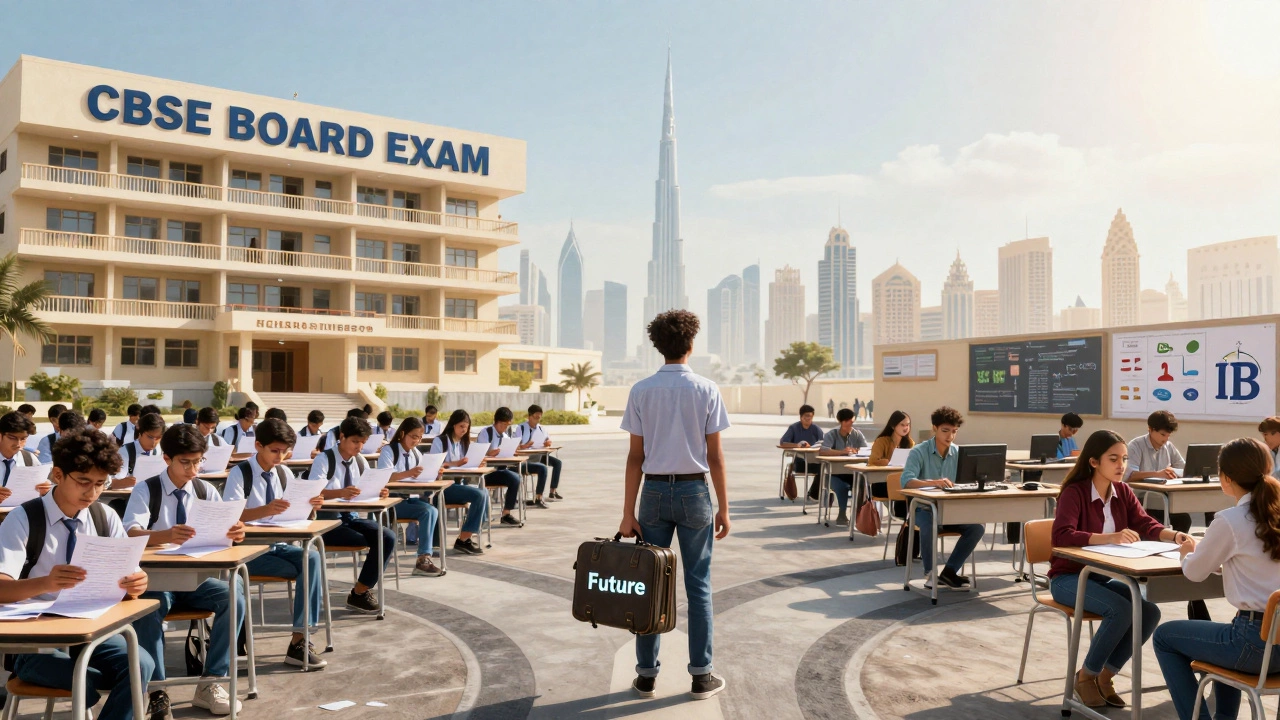
Who Should Consider Dubai’s International Schools?
- Parents aiming for universities outside India (US, UK, Canada, Australia)
- Students who learn by doing, discussing, and creating - not memorizing
- Families willing to pay premium fees for global exposure and critical thinking training
What About CBSE Schools in Dubai?
Many expat families in Dubai choose CBSE schools because they want continuity - especially if they plan to return to India. The curriculum is identical. The textbooks are the same. The board exam is identical. The only difference? The cost. A CBSE school in Dubai charges $8,000-$15,000 per year. In India, it’s $500-$2,000.
Is it worth it? For some, yes. If you want your child to take the same exams, with the same pressure, but in cleaner classrooms with smaller class sizes - then it’s a lifestyle choice. Not an educational upgrade.
The Bottom Line
Dubai education isn’t "better" than India’s. It’s different. CBSE builds strong technical foundations. International schools build adaptable minds. One prepares you for a national exam. The other prepares you for a global career.
If your child’s future is rooted in India - especially in engineering, medicine, or civil services - CBSE is still the most efficient path. But if you’re thinking beyond borders, beyond exams, and beyond memorization - then Dubai’s international schools offer something CBSE rarely does: the freedom to think.
Is CBSE accepted in Dubai schools?
Yes, many international schools in Dubai offer the CBSE curriculum. These schools follow the same syllabus, use NCERT textbooks, and conduct the same Class 10 and Class 12 board exams as schools in India. They’re popular among Indian expat families who plan to return to India for higher education or government jobs.
Can a CBSE student get into Harvard or Oxford?
Yes, but it’s harder. CBSE students need strong SAT/ACT scores, compelling personal essays, extracurricular achievements, and often, additional qualifications like AP courses or IB certificates. Top global universities look for more than exam scores - they want critical thinking, leadership, and creativity, which CBSE doesn’t always emphasize.
Do Dubai schools have better facilities than Indian schools?
Generally, yes. Most international schools in Dubai have modern labs, robotics centers, AI tools, and sports facilities. Many Indian CBSE schools - especially outside major cities - still struggle with basic infrastructure like functional science labs, libraries, or internet access. But this isn’t about the curriculum - it’s about funding and location.
Is the IB curriculum harder than CBSE?
It’s not harder - it’s different. IB requires students to write research papers, complete community service, and think critically across subjects. CBSE focuses on mastering a fixed syllabus and excelling in high-stakes exams. IB demands more time and creativity. CBSE demands more discipline and memorization. Which is "harder" depends on the student’s strengths.
Which system prepares students better for the real world?
IB and British curriculum schools in Dubai tend to prepare students better for global careers because they emphasize communication, problem-solving, and independent research. CBSE prepares students exceptionally well for structured, exam-based systems - like India’s engineering and medical entrance tests. The "real world" isn’t one thing. It depends on where you’re going.
