
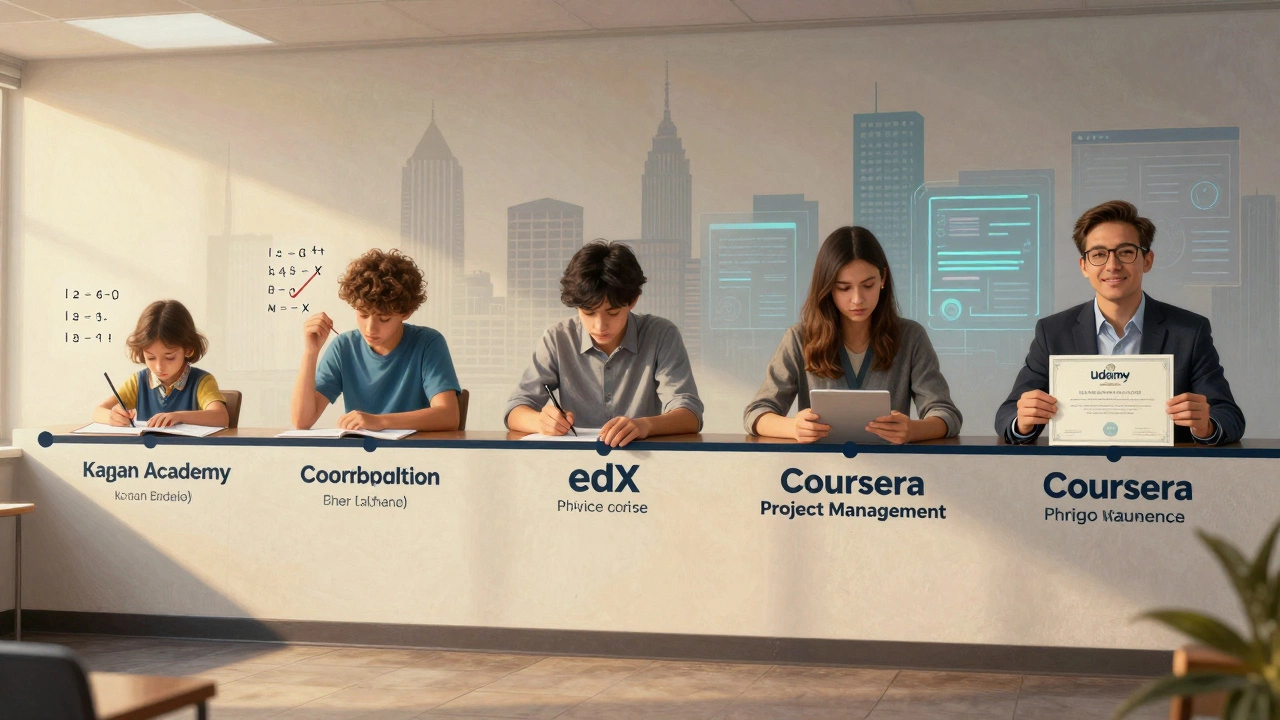
When you’re trying to learn something new-whether it’s coding, business strategy, or how to speak Spanish-you don’t need to enroll in a full-time course or commute to a campus. All you need is an internet connection and the right platform. But with so many options out there, which ones actually deliver? In 2026, four online learning platforms stand out because they’re used by millions, backed by credible institutions, and built to help people actually learn, not just watch videos.
Coursera: Learn from Top Universities
Coursera isn’t just another video library. It’s a partnership between universities like Stanford, Yale, and the University of London, and companies like Google and IBM. You can take full degree programs here, from bachelor’s to master’s, or just pick up a professional certificate in data analysis or project management. What makes Coursera different? The structure. Most courses include graded assignments, peer-reviewed projects, and even proctored exams. If you want something that looks real on your resume, this is one of the few platforms that makes it happen. Over 130 million learners have used Coursera since 2012, and more than 70% of employers say they recognize its certificates.
Udemy: Learn Anything, Anytime
If you’re looking for variety, Udemy is the place. With over 215,000 courses on topics ranging from Python programming to cake decorating, it’s like an online marketplace for knowledge. Anyone can create a course here-teachers, industry pros, even hobbyists. That means the quality varies. But it also means you’ll find niche skills you won’t see anywhere else, like how to use Notion for personal productivity or how to build a Shopify store from scratch. Courses are usually priced between $10 and $20 during sales, and they’re lifetime access. No subscriptions. No deadlines. Just hit play when you have 20 minutes. It’s perfect for people who learn in bursts, not schedules.
edX: The Nonprofit Alternative
Founded by MIT and Harvard in 2012, edX was built to make elite education free and open. While it now charges for certificates, the core content remains free to audit. You’ll find real university courses here-like MIT’s Introduction to Computer Science or Berkeley’s Data Science course-with the same syllabus, readings, and exams as on-campus students. What’s unique about edX? It’s nonprofit. That means it doesn’t push you to buy more courses. It’s focused on learning, not profit. If you’re serious about academics, edX gives you the closest thing to a real college experience without the tuition. Over 35 million learners have taken edX courses, and many universities accept their credits toward degrees.
Khan Academy: Free Learning for Everyone
Khan Academy is the quiet giant. No ads. No paywalls. No certificates you need to pay for. It’s completely free, funded by donations and grants. It started with math tutorials for a student in California and grew into a global resource for K-12, college prep, and even SAT and AP test prep. The videos are short, clear, and taught in plain language. You can’t get a degree here, but you can master the fundamentals. If you’re a student, a parent helping a child, or someone trying to rebuild their math skills after years out of school, Khan Academy is the most reliable free tool out there. It’s used by over 150 million learners worldwide, and teachers in over 190 countries assign it as homework.
Why These Four? What Sets Them Apart
There are dozens of platforms claiming to be the best. But these four work because they solve different problems:
- Coursera = Credentials you can show employers
- Udemy = Skills you need right now, no matter how specific
- edX = Academic rigor without the cost
- Khan Academy = Free, reliable basics for learners of all ages
You don’t need all four. But knowing what each does helps you pick the right one for your goal. Want a promotion? Go with Coursera. Need to fix your Excel skills for a job? Udemy. Prepping for college? edX. Helping your kid with algebra? Khan Academy.
What You Should Avoid
Not all platforms are created equal. Stay away from ones that:
- Only offer video without practice or feedback
- Require monthly payments for access to one course
- Promise certifications that no employer recognizes
- Have no clear instructor credentials
Many platforms use flashy ads and fake testimonials. If a course says "Become a data scientist in 7 days!" and doesn’t list who teaches it, skip it. Real learning takes time, structure, and accountability. The four platforms above have proven they deliver that.
How to Choose the Right One for You
Ask yourself three questions:
- What’s your goal? Job promotion? Academic credit? Personal growth?
- How much time do you have? A few hours a week? Or are you ready to commit to a 6-month program?
- Are you willing to pay? Some platforms offer free content, but certificates cost money. Decide if that’s worth it.
For example:
- If you’re a working professional aiming for a raise → Coursera
- If you’re learning a new skill for fun → Udemy
- If you’re a high school student prepping for college → edX
- If you’re helping a child with homework or rebuilding your own math skills → Khan Academy
There’s no "best" platform. Only the best one for your situation.
Are these platforms free to use?
Khan Academy is completely free. Coursera and edX let you audit most courses for free, but you pay if you want a certificate or graded assignments. Udemy courses are usually paid, but they often go on sale for under $15. You don’t need to pay to learn-just to get official proof.
Can I get a degree from any of these platforms?
Yes-only Coursera and edX offer full online degrees. Coursera partners with universities to deliver bachelor’s and master’s programs you can complete entirely online. edX offers micro-bachelors and micro-masters that can count toward a full degree if you enroll in a partner university. Udemy and Khan Academy don’t offer degrees.
Do employers recognize certificates from these platforms?
Coursera and edX certificates are widely recognized because they come from accredited universities. Udemy certificates are less formal but still valuable if you can show the skills you learned-like building a website or analyzing data. Khan Academy doesn’t issue certificates, but listing what you’ve learned on your resume (e.g., "Completed all Khan Academy AP Calculus modules") can still impress.
Which platform is best for beginners?
Khan Academy is the easiest starting point. Its lessons are short, visual, and assume no prior knowledge. If you’re completely new to a subject, start there. Once you’re ready to go deeper, move to Coursera or edX for more structure. Udemy works too if you pick a well-reviewed course with clear ratings.
Can I use these platforms on my phone?
All four have mobile apps for iOS and Android. You can watch videos, complete quizzes, and track progress on the go. Khan Academy and Coursera work especially well offline-you can download lessons and watch them without Wi-Fi.
