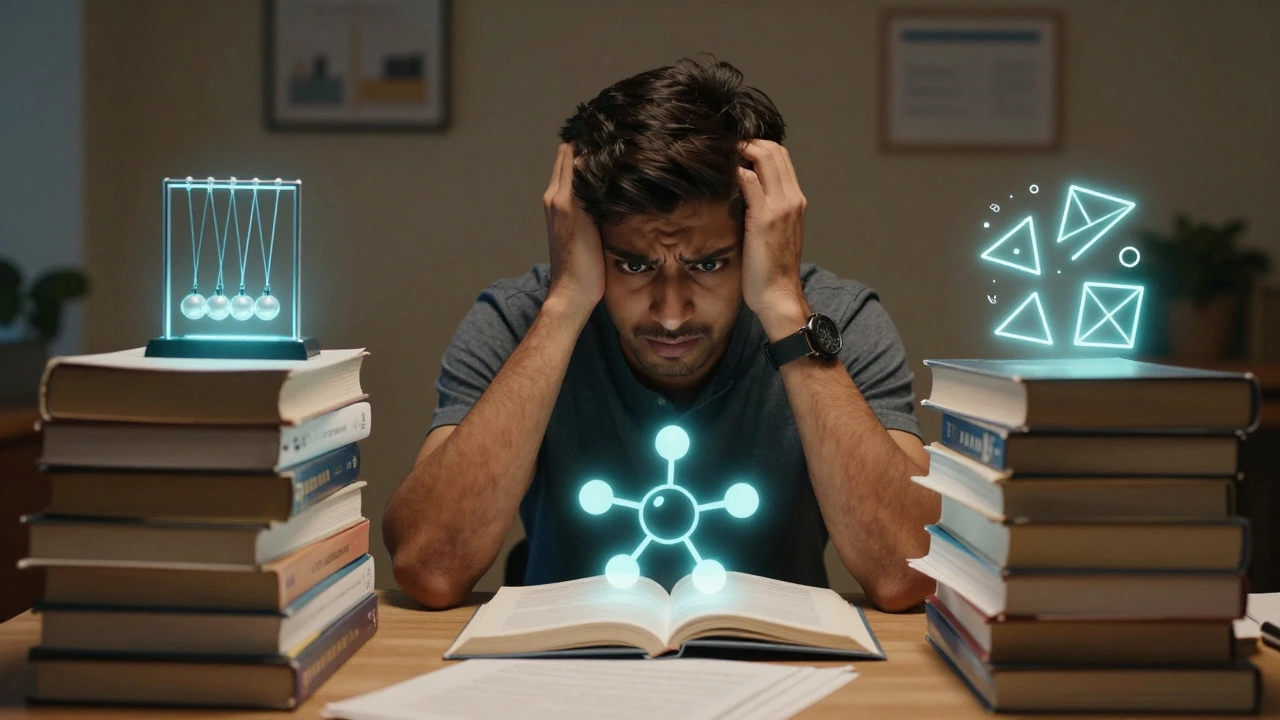
Answer these questions honestly to discover which subject might be your biggest challenge in IIT JEE preparation.
Your Subject Difficulty Profile
There is a myth that floats around every coaching center in Kota and every study group in Mumbai: one subject is significantly harder than the others. Students whisper about it during breaks, parents ask about it at dinner, and toppers debate it on forums. But if you ask ten different students which subject is the hardest in IIT JEE is the premier engineering entrance examination in India, consisting of two stages: JEE Main and JEE Advanced, you will get three different answers.
The truth is not as simple as pointing to a single textbook. The "hardest" subject depends entirely on your brain’s wiring. Do you struggle with abstract visualization? You might hate Physics. Do you freeze when faced with long, multi-step calculations? Mathematics might be your nightmare. Are you overwhelmed by rote memorization and exceptions? Chemistry could be your bottleneck.
To figure out where you stand, we need to break down the three pillars of the exam-Physics, Chemistry, and Mathematics-and look at what actually makes them difficult. It isn’t just about the volume of content; it’s about the type of thinking required.
Why Physics Feels Like the Boss Level
For many aspirants, Physics is the branch of science concerned with the nature and properties of matter and energy is the most intimidating subject. Why? Because it demands a dual skill set. You cannot solve a complex problem in Mechanics or Electrodynamics unless you have a rock-solid grasp of Calculus and Algebra. If your math foundation is shaky, Physics becomes an impenetrable wall.
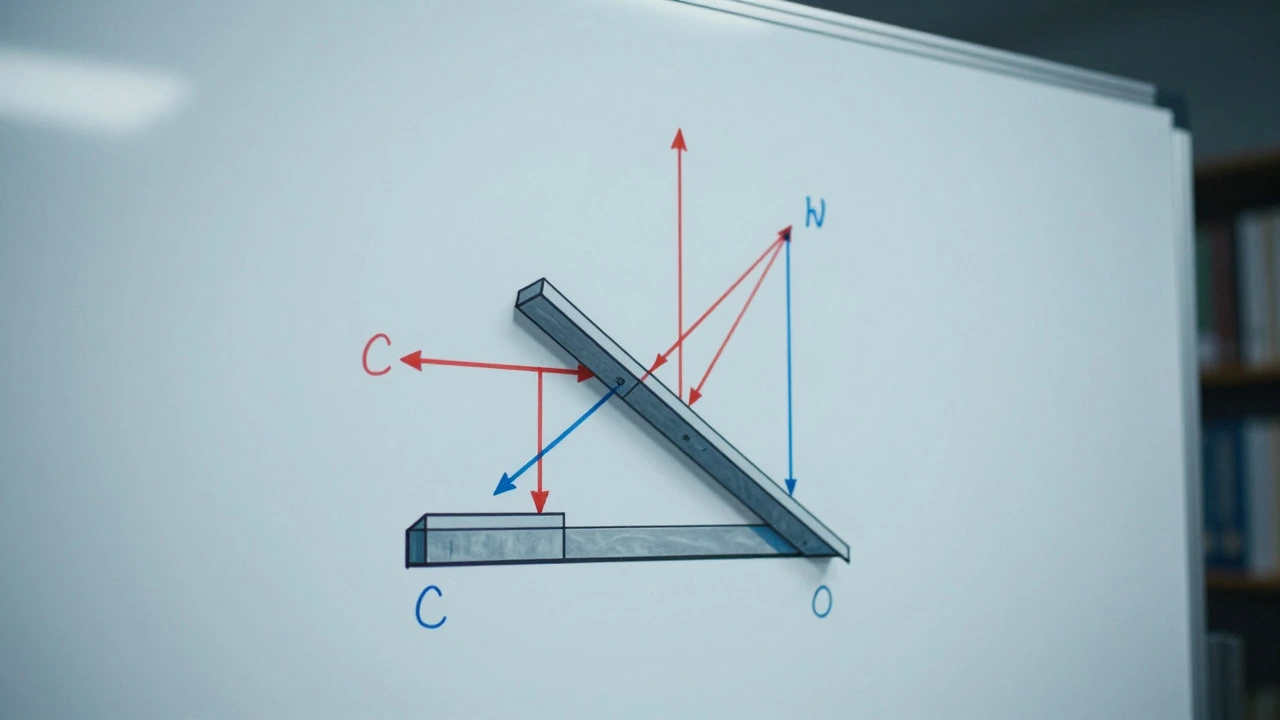
The difficulty in Physics comes from its conceptual depth. In school, you might have learned formulas like F=ma and applied them to simple block-and-pulley systems. In JEE Advanced, those blocks are sliding on inclined planes inside accelerating trucks while dealing with friction coefficients that change over time. You aren't just plugging numbers into a formula; you are building a mental model of a physical system from scratch.
- Mechanics: This is the backbone of Physics. It requires strong visualization skills. If you can't picture the forces acting on a body in your head, you will get stuck.
- Electrostatics and Magnetism: These topics involve vector calculus and abstract fields. You are dealing with invisible forces, which makes them harder to intuitively understand compared to pushing a box.
- Modern Physics: Ironically, this is often considered the "easy" part because it relies more on direct formula application than deep derivation. However, missing a small constant here can cost you marks quickly.
If you love solving puzzles and enjoy visualizing how things move and interact, Physics might actually be your favorite. But if you struggle with applying mathematical tools to real-world scenarios, it will feel like the hardest mountain to climb.
The Trap of Chemistry: Memorization vs. Logic
Chemistry is often misunderstood. Many students walk into their prep thinking it’s just about memorizing reactions and periodic table trends. They start cramming Organic Chemistry mechanisms weeks before the exam, only to realize they don’t understand the underlying logic. This approach fails miserably in JEE.
Chemistry is divided into three distinct parts, each with a different flavor of difficulty:
- Inorganic Chemistry: This is the pure memory game. You need to know coordination compounds, p-block elements, and metallurgy inside out. The challenge here isn’t understanding; it’s retention. The NCERT book is your bible here. Deviating from it or trying to find "shortcuts" usually backfires. For students who dislike rote learning, this section feels tedious and frustrating.
- Organic Chemistry: This is less about memory and more about pattern recognition. Once you understand electron movement (GOC - General Organic Chemistry), reactions start making sense. The difficulty lies in the number of named reactions and reagents. If you miss one step in a multi-step synthesis question, the whole answer is wrong.
- Physical Chemistry: This is essentially Physics disguised as Chemistry. It involves thermodynamics, chemical kinetics, and electrochemistry. It requires heavy calculation and numerical ability. If you are good at math, this part is straightforward. If you aren’t, it becomes a source of significant anxiety.
Chemistry is often called the "scoring" subject because it has a high weightage and relatively predictable patterns. However, its difficulty spikes for students who try to learn it superficially. Depth is non-negotiable here.
Mathematics: The Time Thief
If Physics tests your concept-application balance and Chemistry tests your memory-logic mix, Mathematics is the study of numbers, quantities, shapes, and patterns using logical reasoning tests your speed and accuracy under pressure. Many toppers admit that Math is the subject that costs them the most time per question.
The syllabus for Math in JEE is vast. It covers everything from basic trigonometry to complex integration and 3D geometry. The problems are rarely straightforward. A typical JEE Advanced Math question might require you to use concepts from Coordinate Geometry, Calculus, and Algebra simultaneously.
Here is why Math feels so hard:
- Lengthy Solutions: Unlike Physics, where you might find a shortcut through a clever force diagram, Math problems often require rigorous, step-by-step derivation. One small arithmetic error in the middle of a five-line integral calculation ruins the entire answer.
- Abstract Nature: Topics like Complex Numbers and Matrices & Determinants deal with abstract structures. Without practice, these concepts feel disconnected from reality, making them harder to retain.
- High Variance: Some years, the Math paper is notoriously tough. In recent exams, questions have become more twisted, requiring lateral thinking rather than standard formula application. This unpredictability adds to the stress.
For students who are naturally quick with numbers and enjoy logical deduction, Math is manageable. But for those who prefer conceptual understanding over procedural execution, Math can feel like a relentless grind.
Comparing the Difficulty: A Practical View
To help you gauge which subject might be your personal hurdle, let’s look at a comparison based on common student pain points.
| Factor | Physics | Chemistry | Mathematics |
|---|---|---|---|
| Primary Skill Needed | Conceptual Visualization + Math | Memory + Logical Deduction | Speed + Accuracy + Logic |
| Biggest Pitfall | Ignoring basics/calculus | Rote learning without understanding | Silly mistakes in calculation |
| Time Per Question | Moderate to High | Low to Moderate | High |
| Scoring Potential | High if concepts are clear | Highest (if NCERT is mastered) | Moderate (due to time constraints) |
| Hardest Topic | Electrodynamics / Rotational Motion | Organic Mechanisms / Coordination Compounds | Calculus / Probability |
Notice that Chemistry often has the lowest time-per-question ratio. This is why smart strategists treat Chemistry as their safety net. If you are running out of time in the exam, you should be able to breeze through Chemistry questions to secure marks. Physics and Math require more mental bandwidth and time, making them riskier if you are not well-prepared.
How to Identify Your Personal "Hardest" Subject
You don’t need to guess which subject is hardest for you. Your mock test scores will tell you exactly where you are leaking marks. But beyond the score, look at *why* you got the question wrong.
If you read a Physics question and couldn’t visualize the scenario, your weakness is conceptual visualization. If you knew the formula but messed up the sign convention, your weakness is attention to detail. If you started a Math problem but ran out of time, your weakness is speed or lack of shortcuts.
Here is a quick self-assessment checklist:
- Do you dread opening the NCERT Chemistry book? If yes, you likely struggle with the volume of information. Focus on active recall techniques rather than passive reading.
- Do you freeze when a Physics problem involves multiple objects? You may need to strengthen your free-body diagram skills and practice breaking complex systems into simpler parts.
- Do you make calculation errors in Math even when you know the method? This is a common issue. Practice mental math and double-checking steps. Speed comes with familiarity, not rushing.
Remember, the goal isn’t to eliminate the "hard" subject but to bring it up to par with your strengths. In JEE, balance is key. A student who scores 90% in Math and Physics but only 50% in Chemistry will likely rank lower than a student who scores 80% across all three subjects.
Strategies to Tackle the Tough Stuff
Once you’ve identified your weak link, how do you fix it? The approach varies by subject.
For Physics: Go back to the fundamentals. Don’t jump into advanced problems until you can derive the basic equations yourself. Use resources like HC Verma for conceptual clarity before moving to Irodov or Cengage for advanced practice. Visualize every problem. Draw diagrams. If you can’t draw it, you don’t understand it.
For Chemistry: Make notes. Short, crisp notes for Inorganic Chemistry. Reaction maps for Organic Chemistry. For Physical Chemistry, treat it like Math-practice numericals daily. Never ignore NCERT for Inorganic and Organic. It is the source of truth for JEE.
For Mathematics: Practice variety. Don’t just solve 50 similar integration problems. Solve one from each chapter daily to keep your mind agile. Learn shortcuts, but only after mastering the standard methods. Time yourself strictly during practice sessions to simulate exam pressure.
Consistency beats intensity. Studying for 10 hours one day and zero the next won’t help. Two focused hours every day for six months will build the neural pathways needed to tackle the hardest questions.
Final Thoughts on Subject Difficulty
So, what is the hardest subject in IIT JEE? There is no universal answer. For some, it’s the abstract vectors of Physics. For others, it’s the endless reactions of Organic Chemistry. For many, it’s the time-consuming integrals of Mathematics.
The "hardest" subject is simply the one you haven’t practiced enough. The beauty of JEE preparation is that it is malleable. With targeted effort, any weak subject can become a strength. Stop worrying about which subject is objectively harder and start focusing on which subject is currently holding you back. That is the only metric that matters.
Is Physics really the hardest subject in JEE Advanced?
Not necessarily. While Physics is challenging due to its reliance on both conceptual understanding and mathematical application, many students find Mathematics harder because of the time it takes to solve problems accurately. The difficulty is subjective and depends on your individual strengths in visualization versus calculation.
Which subject has the highest weightage in JEE?
All three subjects-Physics, Chemistry, and Mathematics-have equal weightage in both JEE Main and JEE Advanced. Each subject contributes equally to your total score, so neglecting any one of them can significantly impact your overall rank.
Can I skip Inorganic Chemistry if I find it too hard?
No, skipping Inorganic Chemistry is a major mistake. It is often considered the most scoring section because questions are directly based on NCERT text. With consistent revision and note-making, it is manageable for most students and provides a crucial boost to your total score.
How much time should I dedicate to each subject daily?
A balanced approach is recommended. Ideally, spend equal time on all three subjects, but adjust based on your weaknesses. If Math is your weak point, you might allocate slightly more time to it initially, but ensure you don't neglect Chemistry, which requires regular revision to retain facts.
Why do many students find Mathematics the most stressful?
Mathematics is often stressful because it is time-intensive. Questions can be lengthy and prone to calculation errors. Additionally, the syllabus is vast, covering diverse topics from Algebra to Calculus, requiring consistent practice across all areas to maintain proficiency.
