Find Your Ideal Board Match
Answer these questions honestly to find out which board aligns best with your natural aptitude.
Walk into any coaching center in Kota or a tuition hub in Mumbai, and you will hear the same question asked by anxious parents: "Which board is harder?" The answer isn't simple. It depends on what you mean by "hard." Are we talking about memorizing vast amounts of literature? Solving complex physics problems under pressure? Or simply navigating a rigid exam structure?
In India, school education is governed by various boards, each with its own philosophy. When people ask which is the toughest board in India, they are usually comparing three giants: Central Board of Secondary Education (CBSE), the most widely followed board known for its alignment with national competitive exams, the Indian Certificate of Secondary Education (ICSE), known for its detailed curriculum and emphasis on language and arts, and the various State Boards, regional education bodies that vary significantly in difficulty and quality across different states.
The Case for CBSE: Difficulty Through Competition
Many students argue that CBSE syllabus is the toughest not because the content is inherently deeper than others, but because of the stakes attached to it. CBSE is designed to prepare students for national-level entrance exams like JEE (Joint Entrance Examination) and NEET (National Eligibility cum Entrance Test). This alignment creates a unique kind of pressure.
The difficulty here lies in the application of concepts. CBSE questions often require logical reasoning and quick problem-solving skills rather than rote memorization. For example, in Mathematics, a CBSE student might face a multi-step calculus problem that tests their understanding of underlying principles, whereas another board might ask them to reproduce a standard formula derivation. The former is harder if you haven't practiced enough; the latter is harder if you haven't memorized enough.
Furthermore, the sheer volume of students taking CBSE exams means that grading can be stricter. With millions of candidates competing for top ranks, the margin for error is slim. A single mistake in a numerical answer can drop your percentile significantly. This competitive environment makes the board feel "tougher" to many aspirants aiming for IITs or AIIMS.
The ICSE Challenge: Breadth and Depth
If CBSE is tough due to competition, Council for the Indian School Certificate Examinations (CISCE), the governing body for ICSE and ISC boards is tough due to workload. ICSE is famous for its comprehensive curriculum. Students following this board often report studying more subjects in greater detail compared to their CBSE counterparts.
Consider English. In CBSE, you might read two novels and write essays based on prescribed formats. In ICSE, the focus is on extensive reading, creative writing, and a deeper analysis of literary texts. The vocabulary expected from an ICSE student is generally higher. If you are weak in languages, ICSE will feel significantly harder.
Science subjects in ICSE also demand conceptual clarity combined with descriptive answers. Unlike the objective-heavy trend in some other boards, ICSE values long-form answers where you must explain the 'why' behind every step. This requires a different kind of mental stamina. You cannot just guess your way through an ICSE paper; you need to have internalized the material.
| Feature | CBSE | ICSE | State Boards (Avg.) |
|---|---|---|---|
| Curriculum Breadth | Moderate, focused on core STEM | Wide, includes detailed arts/languages | Varies by state, often localized |
| Exam Pattern | Standardized, pattern-based | Descriptive, analytical | Often memory-based |
| Competitive Alignment | High (JEE/NEET friendly) | Low (requires extra prep) | Very Low |
| Language Requirement | Functional proficiency | Advanced proficiency | Regional language focus |
State Boards: The Variable Factor
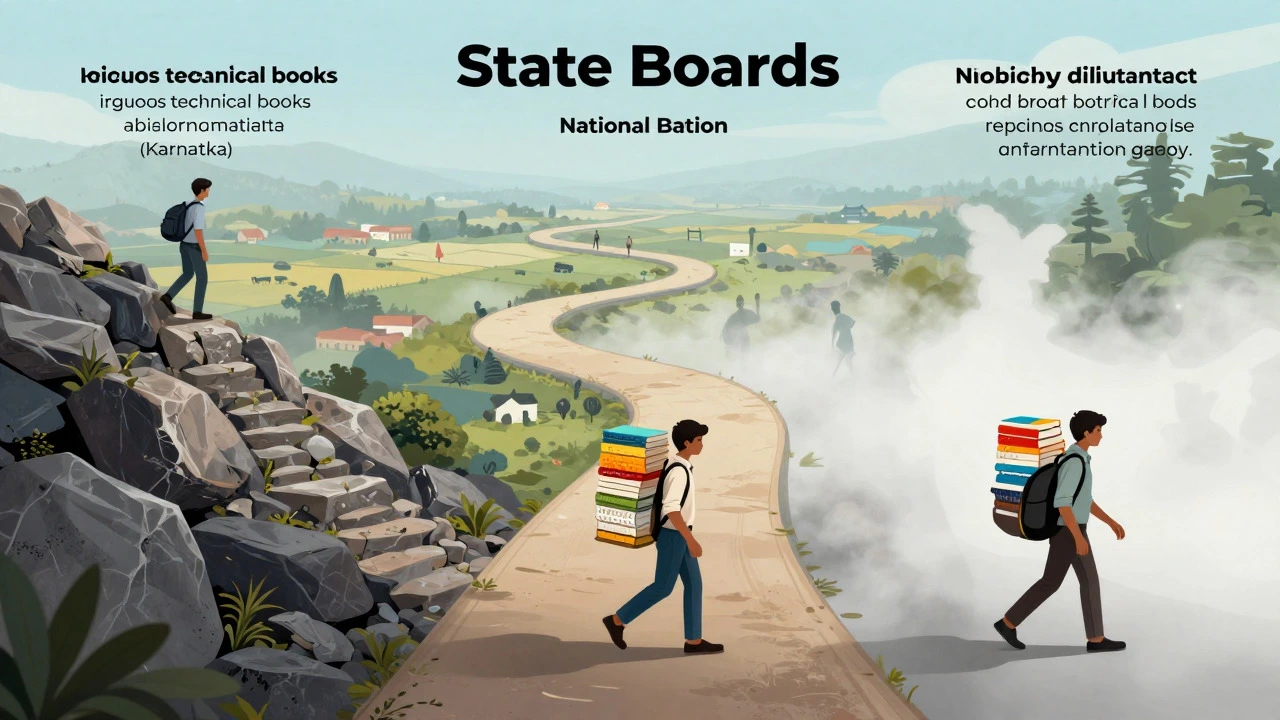
Calling all state boards "easy" is a misconception. The difficulty level varies wildly depending on the state. For instance, the Maharashtra State Board, education board for Maharashtra known for rigorous technical education and the Karnataka Secondary Education Examination Board (KSEEB), board serving Karnataka with strong science and commerce streams are considered quite challenging, especially in science and mathematics.
However, the primary challenge with state boards is often inconsistency. One year's paper might be straightforward, while the next could be unexpectedly difficult. Additionally, the medium of instruction can be a barrier. If a student is learning complex scientific concepts in a regional language while preparing for English-medium competitive exams, the cognitive load doubles. This linguistic gap makes the effective difficulty higher for those aiming for national opportunities.
Why CBSE Often Takes the Top Spot for "Toughest"
When we look at data regarding pass percentages and rank distribution, CBSE often appears as the most demanding. Here is why:
- Strict Evaluation Criteria: CBSE marking schemes are precise. There is little room for subjective interpretation in science and math answers. If the steps are missing, marks are deducted.
- Time Pressure: The volume of questions in CBSE papers, particularly in Physics and Chemistry, requires fast calculation skills. Many students struggle not with knowing the answer, but with finishing the paper on time.
- Uniformity: Since CBSE is conducted simultaneously across hundreds of centers, the paper is standardized. This means a student in Delhi faces the exact same difficulty as a student in Chennai. In contrast, state boards may have variations that some students find easier to predict.
For a student targeting engineering or medicine, the CBSE syllabus acts as a double-edged sword. It covers the necessary ground for JEE Main and NEET, but it does so without holding your hand. You are expected to bridge the gap between school-level understanding and competitive-level application yourself.
How to Choose Based on Your Strengths
Instead of asking which board is objectively tougher, ask which board matches your learning style. If you are good at logic, quick calculations, and handling high-pressure environments, CBSE might suit you. If you excel in writing, deep analysis, and managing a heavy workload of diverse subjects, ICSE could be your strength.
Remember, the "toughest" board is the one that doesn't align with your natural aptitude. A student who loves literature will find ICSE manageable and CBSE restrictive. A student obsessed with robotics and coding will find CBSE supportive and ICSE overwhelming. The key is to pick the path that challenges you in ways that help you grow, not just break you down.
Is CBSE really harder than ICSE?
It depends on how you define hard. CBSE is harder in terms of competitive pressure and speed required for solving problems. ICSE is harder in terms of the volume of content to memorize and the depth of language skills required. For engineering aspirants, CBSE feels harder because it directly mirrors the JEE pattern.
Which board is best for IIT JEE preparation?
CBSE is generally considered the best fit for IIT JEE preparation because its syllabus overlaps significantly with the JEE Main and Advanced curricula. However, students from ICSE and State boards also clear JEE every year; they just need to spend extra time aligning their school studies with competitive exam requirements.
Are State Boards easier to pass?
Generally, yes, pass rates in many state boards are higher than in CBSE or ICSE. However, scoring very high marks (95%+) can be equally difficult in top-performing states like Maharashtra and Karnataka due to strict evaluation standards and large candidate pools.
Can I switch from ICSE to CBSE in Class 11?
Yes, you can switch boards in Class 11. Many students do this to better align with engineering or medical entrance exams. However, be prepared for a change in teaching style and exam patterns. You may need to adapt to more objective-type questions and faster-paced problem solving.
Does the board choice affect college admissions abroad?
Most international universities recognize both CBSE and ICSE qualifications equally. ICSE is sometimes viewed favorably for its strong English and holistic curriculum, but CBSE is widely accepted due to its global presence. What matters more is your final percentage and extracurricular achievements.
