
If you’re looking to land a job quickly, not just learn something cool, then the course you pick matters more than you think. It’s not about prestige or how fancy the certificate looks. It’s about what employers actually need right now - and what they’re willing to pay for.
Not all online courses are made equal
You’ve seen the ads: "Get hired in 30 days!" "Earn $80K after this course!" Most of them are hype. But there are real courses out there - backed by hiring data, industry demand, and actual job placements - that move the needle. The difference? They focus on skills, not theory.
Take coding bootcamps. They’ve been around long enough now that we can see the results. A 2024 report from the Council on Integrity in Results Reporting (CIRR) tracked over 12,000 graduates from 150 U.S.-based coding bootcamps. Nearly 78% landed a job in tech within six months. That’s not luck. It’s design. These programs don’t waste time on abstract math or history of programming languages. They teach you how to build real apps, fix real bugs, and work in teams using tools companies use every day: React, Python, SQL, Git, and cloud platforms like AWS.
What’s actually hiring right now?
Let’s cut through the noise. In late 2025, the top three job categories hiring aggressively for remote and hybrid roles are:
- Cybersecurity analysts - Companies are getting hacked daily. They need people who can monitor systems, spot threats, and respond fast. Certifications like CompTIA Security+ or Google Cybersecurity Certificate open doors even without a degree.
- Data analysts - Every business, from local shops to global banks, needs to understand their numbers. You don’t need to be a statistician. You need to know Excel, Google Sheets, SQL, and how to make a dashboard in Tableau or Power BI. That’s it.
- AI prompt engineers and automation specialists - This isn’t sci-fi anymore. Businesses are using AI to cut hours of manual work. Someone who can write clear prompts, connect tools like Zapier or Make.com, and automate email workflows, data entry, or customer replies is in high demand.
These aren’t niche roles. They’re entry-level positions with salaries starting at $50K-$70K in the U.S., and similar pay in Australia, Canada, and New Zealand. And you don’t need a four-year degree to get them.
The best courses for fast job placement
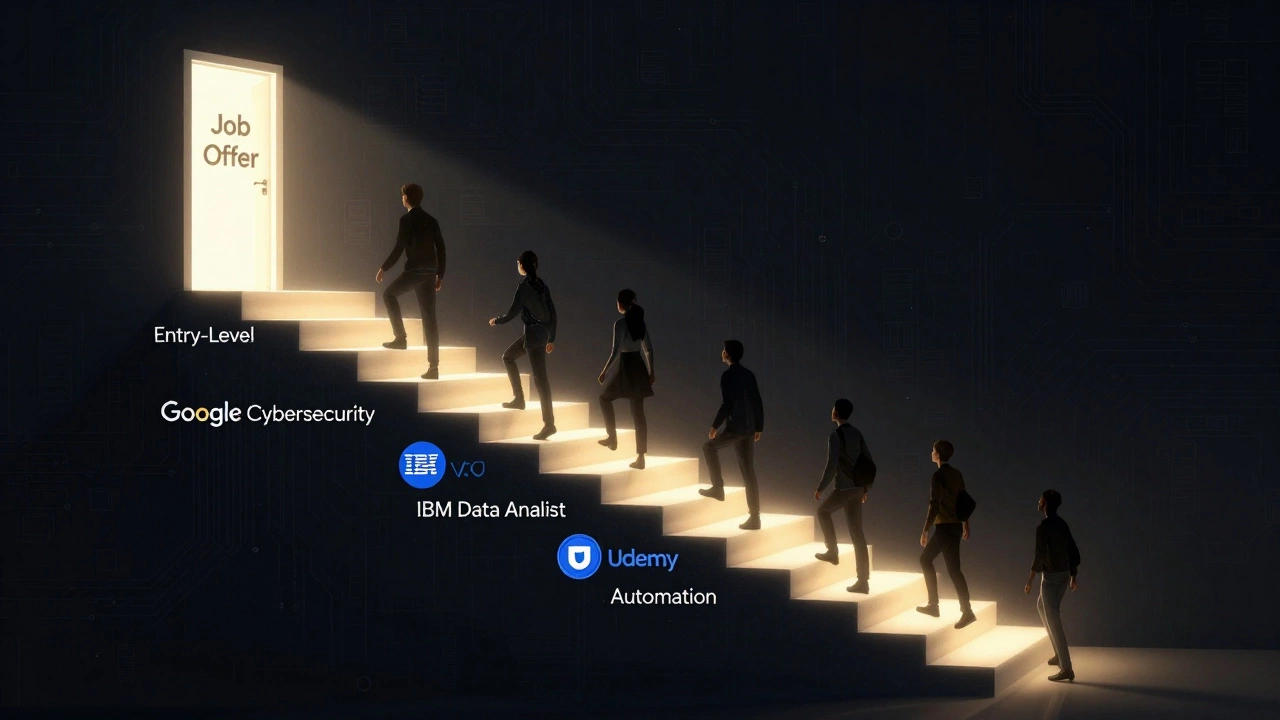
Here are the three most reliable online courses that consistently lead to jobs - based on graduate surveys, employer feedback, and hiring trends in 2025.
1. Google Cybersecurity Professional Certificate (Coursera)
This six-month course, offered through Coursera in partnership with Google, teaches you how to detect security threats, manage identity and access, and respond to incidents. It’s designed for beginners. No prior tech experience needed. The final project simulates a real-world security breach. Employers recognize this certificate because Google backs it. Over 100,000 people have completed it, and more than 60% reported a positive career outcome - new job, promotion, or raise - within six months.
2. IBM Data Analyst Professional Certificate (Coursera)
If you like numbers but hate math class, this is your path. You’ll learn to clean messy data, build visual dashboards, and write SQL queries to pull insights from databases. You’ll use real datasets from retail, healthcare, and finance. The course ends with a capstone project where you analyze real company data and present findings - exactly what you’d do on the job. IBM partners with over 150 U.S. employers who actively recruit from this program. Many graduates land roles like Junior Data Analyst or Business Intelligence Associate.
3. AI & Automation with Zapier and Make.com (Udemy)
This isn’t about building AI. It’s about using it. This course teaches you how to connect apps so they work together automatically. For example: when someone fills out a Google Form, automatically add their info to a spreadsheet, send a thank-you email, and schedule a calendar reminder. That’s the kind of work companies pay $45-$65/hour for. You don’t need to code. You just need to understand logic and workflow. Udemy’s top-rated course in this space has over 200,000 students. Many have turned it into freelance gigs or full-time roles as Operations Analysts or Process Automation Specialists.

What to avoid
Not every course that says "job guarantee" delivers. Stay away from:
- Courses that promise "get rich quick" with crypto or NFTs
- Programs that only give you a PDF and a certificate with no hands-on projects
- Anything that requires you to pay thousands upfront without a refund policy
Legit courses give you access to real tools, let you build a portfolio, and offer career support - resume reviews, interview prep, job boards. If they don’t, they’re not helping you get hired. They’re selling a dream.
How to pick the right one for you
Ask yourself three questions:
- Do I enjoy solving problems? If yes, cybersecurity or data analysis could be a fit.
- Do I like working with computers but hate writing code? Then automation and AI tools are your sweet spot.
- Can I spend 10-15 hours a week for 3-6 months? Consistency beats intensity. Even 20 minutes a day adds up.
Start with free trials. Google’s cybersecurity course lets you audit the first module for free. Udemy has weekly sales where courses drop to $10. Try before you commit.
Real people, real results
Anna, 32, from Christchurch, was working in retail when she lost her job in early 2024. She spent $49 on the IBM Data Analyst course on sale. In four months, she built a portfolio of three projects - one analyzing local supermarket sales data, another tracking public transport delays, and a third comparing housing prices in her region. She applied to five entry-level roles. Got three interviews. Landed a job at a small marketing agency as a Data Coordinator. Her salary went from $38K to $58K.
James, 28, from Tauranga, took the Google Cybersecurity course while working night shifts. He passed the certification, added it to his LinkedIn, and started commenting on cybersecurity posts. A recruiter reached out after seeing his profile. He now works remotely for a U.S. fintech firm as a Tier 1 Security Analyst.
These aren’t outliers. They’re typical.
What comes next?
Once you land your first job, you’re not done. The tech world moves fast. The next step is building a portfolio, contributing to open-source projects, or getting a more advanced certification like AWS Certified Cloud Practitioner or Microsoft Power BI Data Analyst. But that’s step two. Step one is getting your foot in the door. And that’s what these courses are built for.
You don’t need to be the smartest person in the room. You just need to be the one who can actually do the work - and prove it.
Can I get a job with just an online course and no degree?
Yes. Many companies now prioritize skills over degrees, especially for entry-level tech roles. Employers in cybersecurity, data analysis, and automation care more about what you can do than where you went to school. Certificates from Google, IBM, and Coursera are widely recognized. Build a portfolio of real projects, and you’ll compete with - and often beat - candidates with degrees.
How long does it take to get hired after finishing a course?
Most people who actively apply and network land jobs within 3 to 6 months after finishing a high-quality course. The key isn’t just completing the course - it’s applying what you learned. Build at least three projects, update your LinkedIn, and reach out to 5-10 people in your target field every week. Job search is a job itself.
Are these courses worth the money?
Compared to a four-year degree costing $50K-$100K, yes. The Google Cybersecurity Certificate costs $49/month (total under $300). The IBM Data Analyst course is similar. Even full Udemy courses rarely exceed $200 on sale. If you land a job paying $60K+, you recoup your investment in less than a month. The return on investment is among the highest of any educational purchase you can make.
Do I need to be good at math to do these courses?
Not for cybersecurity or automation. For data analysis, you’ll use basic math - percentages, averages, trends - not calculus or statistics theory. Tools like Excel and Power BI do the heavy lifting. You just need to understand what the numbers mean and how to explain them. If you can balance a budget, you can handle this.
Can I do this while working full-time?
Absolutely. Most of these courses are self-paced. You can do 1-2 hours a night or 4-5 hours on weekends. Many graduates studied during lunch breaks, after kids went to bed, or before their shift started. Consistency matters more than hours. One hour a day, five days a week, will get you there in six months.
