
Daily English Speaking Progress Tracker
Your Progress Journey
Track your daily speaking attempts. Every small win counts!
Your Wins
Most people who want to speak English don’t need to be fluent overnight. They just need to say something without freezing up. The problem isn’t grammar. It’s fear. Fear of sounding silly. Fear of being misunderstood. Fear that everyone else is better. That’s why so many learners spend years studying vocabulary and tenses but still can’t hold a five-minute chat. You don’t need to be perfect. You need to be brave enough to start.
Stop waiting for perfect grammar
You don’t need to know all the tenses before you say your first sentence. Real English isn’t taught in textbooks. It’s heard on buses, in cafes, on Zoom calls, and in YouTube videos where people talk fast, cut words short, and repeat themselves. If you wait until you’ve memorized every rule, you’ll never speak. Start with what you can say right now: "I like coffee," "This is hard," "Can you repeat that?"Think of speaking like learning to ride a bike. You don’t study physics first. You get on, wobble, fall, and try again. The same goes for English. Your brain will fix small mistakes as you hear more. Don’t correct every error while speaking-focus on being understood. People care more about your message than your verb conjugation.
Listen like you’re learning a new song
You didn’t learn your first language by reading grammar books. You listened. Over and over. You heard your mom say "milk," you saw the bottle, you tried to say it. That’s how your brain learned. Do the same with English.Find short audio clips-under 3 minutes-of real people talking. Use YouTube channels like "English Addict with Mr Steve" or "Learn English with Emma." Don’t watch with subtitles at first. Just listen. Try to catch one word you recognize. Then, listen again. This time, try to catch two. After three listens, pause and repeat what you heard out loud. Don’t worry if it sounds odd. Your mouth is learning new shapes.
One beginner in Auckland did this for 15 minutes every morning before work. After six weeks, she could follow a 10-minute podcast about weather patterns. She didn’t know all the words, but she knew the rhythm. That’s how speaking starts-not with memorizing, but with listening until your ears adjust.
Speak to yourself before speaking to others
Talking to yourself isn’t weird. It’s training. When you’re alone, you’re safe. No judgment. No pressure. Start small:- Describe what you’re doing: "I’m making tea. The water is hot. I’m adding sugar."
- Talk about your day: "Today was busy. I saw the bus late. I felt tired."
- Answer simple questions out loud: "What’s your favorite food?" → "Pizza. Because it’s cheesy and warm."
Do this for five minutes every morning. Record yourself once a week. Don’t listen for perfection. Listen for progress. Did you say something without stopping? Did you use a new word? That’s a win. Your confidence grows when you realize you can speak-even if it’s just to an empty room.

Find one person to practice with
You don’t need a class or a tutor. You need one person who won’t laugh at your mistakes. It could be a coworker who speaks English, a neighbor, or someone online. Use free apps like Tandem or HelloTalk. Look for people learning your language. You help them with your native tongue. They help you with English. It’s fair. It’s real.One rule: every conversation must include at least three new words you learned that day. Write them down. Say them again before bed. The next day, try to use them. Don’t memorize lists. Use words in context. "I felt frustrated when the train was late." That sticks better than writing "frustrated: angry."
Don’t wait for someone perfect. Wait for someone kind. Someone who says, "I get what you mean," instead of, "That’s not right."
Use real-life situations as practice
You don’t need to travel to London or New York to speak English. You can practice right where you are:- Order coffee: "Can I get a latte, please? No sugar."
- Ask for help at the library: "Where are the English books?"
- Comment on a local event: "This festival is fun. I’ve never seen fireworks like this."
These aren’t tests. They’re experiments. Each time you speak, you get one step closer to not being afraid. Even if the person answers in your language, you still tried. That counts. Most people will smile and help you. They’ve been beginners too.
Track progress, not perfection
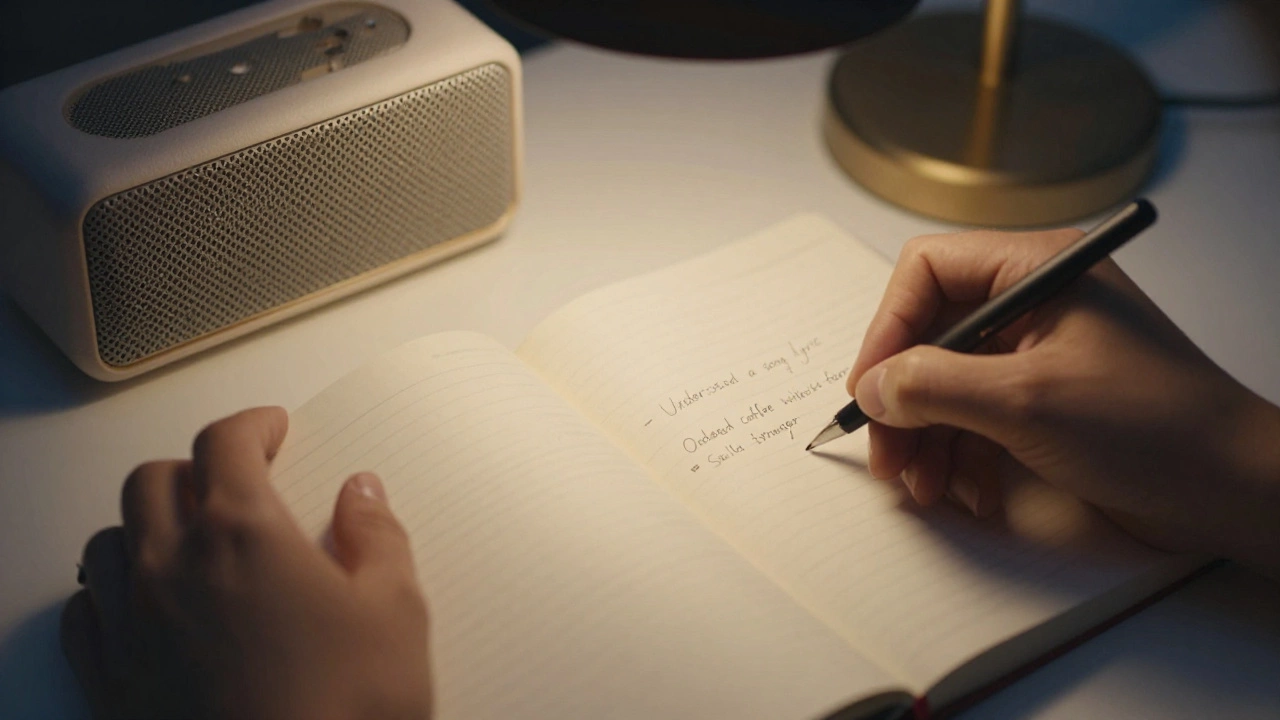
You won’t wake up one day speaking like a native. Progress is slow. But it’s real. Keep a simple journal:- Monday: Said "I’m learning English" to a cashier. She smiled.
- Wednesday: Understood a song lyric for the first time.
- Friday: Watched a 5-minute video without subtitles and got the main idea.
These aren’t big wins on paper. But they’re huge in real life. You’re rewiring your brain. Every time you speak, even badly, you’re building a new neural pathway. It’s not about sounding smart. It’s about being heard.
What to avoid
There are traps every beginner falls into. Don’t let them slow you down:- Don’t translate in your head. If you think "I want water" in your language, then translate it to English, you’ll always be slow. Think in pictures. See the glass. Say "water."
- Don’t memorize long dialogues. Real conversations don’t follow scripts. Learn phrases, not lines.
- Don’t compare yourself to others. Someone who speaks fast online isn’t better. They’ve just practiced longer. Your journey is yours.
The biggest mistake? Waiting. Waiting for the right time. Waiting to be ready. There is no right time. There’s only now.
Start today, not tomorrow
You don’t need a course. You don’t need a certificate. You need to open your mouth and say something. Anything. Even if it’s just "Hello."Tomorrow, when you wake up, say one sentence out loud. Not in your head. Out loud. "I am learning English."
That’s your first step. Not perfect. Not fancy. But real. And that’s all that matters.
How long does it take to start speaking English as a beginner?
Most beginners can say simple sentences confidently in 4 to 8 weeks with daily practice-just 10 to 15 minutes a day. The key isn’t time spent, but consistency. Speaking for 10 minutes every day builds more confidence than studying for 2 hours once a week. You’ll notice small wins: understanding a joke, ordering food without hesitation, or replying to a simple question without pausing.
Do I need to learn grammar to speak English?
No, not at first. You learn grammar naturally by hearing and using the language. Focus on phrases like "I need help," "Can you help me?" or "What does this mean?" These are more useful than memorizing past perfect tense. You’ll pick up grammar rules over time as you hear how native speakers put sentences together. Save grammar study for when you want to write formally or correct mistakes you keep making.
What if I’m too shy to speak?
Start by speaking to yourself. Talk about your routine, your food, your weather. Record your voice. Listen back. It gets easier. Then, find one safe person-a friend, a language partner, an online tutor-who won’t judge you. Most people are happy to help. Remember: everyone makes mistakes. Even native speakers say "um," forget words, and restart sentences. You’re not alone.
Should I use an app to learn English speaking?
Apps can help, but they’re not enough. Apps like Duolingo or Babbel are good for vocabulary and structure. But speaking requires interaction. Use apps to build confidence, then move to real conversations. Try Tandem, HelloTalk, or even a local meetup. The goal is to speak to a person, not just a screen. The best app is the one that connects you to someone who will listen.
Can I learn to speak English without a teacher?
Yes. Many people learn to speak English without a teacher. They use free videos, podcasts, language exchange apps, and real-life practice. The key is active practice-speaking out loud, listening daily, and repeating what you hear. A teacher helps with feedback, but you don’t need one to start. Your willingness to try matters more than who’s guiding you.
If you’re reading this, you’re already on the path. You didn’t just think about speaking English-you looked for a way to start. That’s the hardest part. Now go say something. Even if it’s just "Hello."
