Python vs HTML Learning Path Finder
Let's find your perfect starting point
Answer 3 quick questions about your goals to see if Python or HTML is the best first language for you.
What's your primary goal?
How do you prefer to work?
What kind of results are most motivating?
Your Learning Path
Choosing between Python and HTML as your first coding language feels like picking between a car and a wrench. One lets you build entire websites. The other lets you build entire programs. But which one should you actually start with? The answer isn’t about which is harder or cooler. It’s about what you want to do right now.
HTML Isn’t a Programming Language - And That’s Okay
HTML stands for HyperText Markup Language. It doesn’t do calculations. It doesn’t loop or make decisions. It doesn’t run logic. It’s a structure language. Think of it like the skeleton of a house. It defines where the door goes, where the windows fit, and how rooms are arranged. Without HTML, a website is just a blank canvas.
If you want to build a personal portfolio, a blog, or a simple landing page for your side hustle, HTML is your starting point. You’ll learn tags like <h1>, <p>, and <img>. In a few hours, you can create a webpage that displays your name, a photo, and a link to your Instagram. That’s instant gratification - and it matters.
But here’s the catch: HTML alone can’t make a button work. It can’t validate a form. It can’t show you real-time weather data. For that, you need JavaScript - and then CSS to make it look good. So if your goal is to build interactive websites, HTML is step one, but not the whole journey.
Python Is a Full Programming Language - And It’s Friendly
Python is different. It’s a general-purpose programming language. It can do math, control systems, analyze data, automate tasks, and even build websites. Unlike HTML, Python has variables, loops, conditionals, functions - all the building blocks of real software.
Here’s what you can do in your first day with Python:
- Write a script that renames 100 files in a folder
- Build a calculator that adds, subtracts, multiplies, and divides
- Scrape the weather from a public site and send yourself a text alert
- Automate sending personalized emails to your classmates
Python’s syntax is designed to read like plain English. You don’t need semicolons or curly braces. You write:
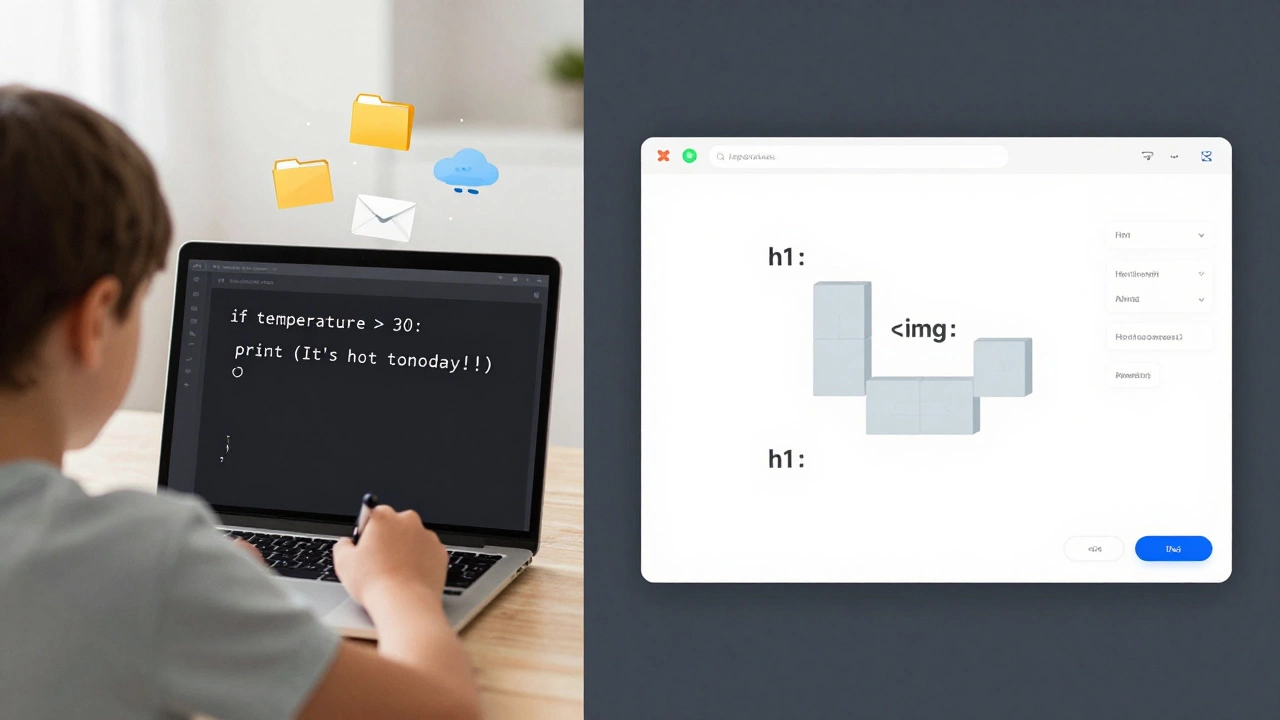
if temperature > 30:
    print("It's hot today!")
And it just works. No weird symbols. No cryptic errors. That’s why over 70% of developers in the 2024 Stack Overflow survey said Python was their most-used language - and why it’s the top choice in schools from New Zealand to Nigeria.
What You Want to Build Determines What You Should Learn First
Let’s cut through the noise. Here’s the real breakdown:
If You Want to Build Websites - Start with HTML
Want to create a site for your art, music, or small business? Start with HTML. Then add CSS to style it. Then add JavaScript to make buttons click and forms submit. This is the classic web dev path. You’ll learn how browsers work. You’ll understand responsive design. You’ll see your work live in a browser within hours.
But here’s the reality: most web jobs today don’t just want HTML. They want React, Vue, or Next.js. And behind those, there’s usually a Python backend (Django or Flask) handling data. So if you start with HTML, you’re starting at the front end. That’s fine - but don’t think it’s the end of the road.
If You Want to Automate, Analyze, or Build Tools - Start with Python
Do you hate filling out spreadsheets by hand? Do you want to download your bank statements and auto-sort them? Do you want to track your Netflix watching habits or organize your photo library? Python can do all of that - and it’s easier than Excel macros.
Python isn’t just for websites. It’s used in:
- Data science (analyzing trends in sales or social media)
- Finance (automating reports, calculating risk)
- Science (processing lab results, simulating models)
- Game development (building simple 2D games)
- AI and machine learning (teaching computers to recognize faces or predict prices)
And you don’t need a degree to start. A high school student in Auckland used Python to build a tool that auto-fills her school’s attendance sheet. She didn’t touch HTML. She just wrote a script that read a CSV file and sent emails.
Most People Who Start with HTML Get Stuck
I’ve seen it too many times. Someone learns HTML. Then CSS. Then JavaScript. They build a beautiful website. But then they hit a wall: “How do I make this website save user data?” “How do I let people log in?” “How do I update this without manually editing every page?”
That’s when they realize: HTML is a tool for structure. It’s not a tool for logic. To go further, they need to learn backend programming - and that’s where Python (or Node.js, or Ruby) comes in. So they end up learning Python anyway - just later.
Starting with Python means you skip that confusion. You learn how software thinks from day one. You learn how to solve problems, not just arrange elements on a screen.
What About the Job Market?
Let’s talk about real jobs.
In New Zealand, job listings for “Junior Developer” often list Python as a required skill - even for roles that aren’t web-focused. Why? Because Python teaches you how to think like a programmer. It’s the gateway language.
HTML and CSS? Those are still essential - but they’re usually listed as “nice to have” for non-web roles. If you’re applying for a data analyst job, they care if you can write a Python script to clean data. They don’t care if you can center a div.
On the flip side, if you want to be a front-end developer - yes, HTML is mandatory. But even there, most modern front-end roles expect you to know at least one framework (React, Vue) - which requires understanding JavaScript logic. And logic? That’s Python’s sweet spot.
What’s the Best Way to Learn Both?
You don’t have to pick forever. But you do need to pick a starting point.
Here’s the smartest path:
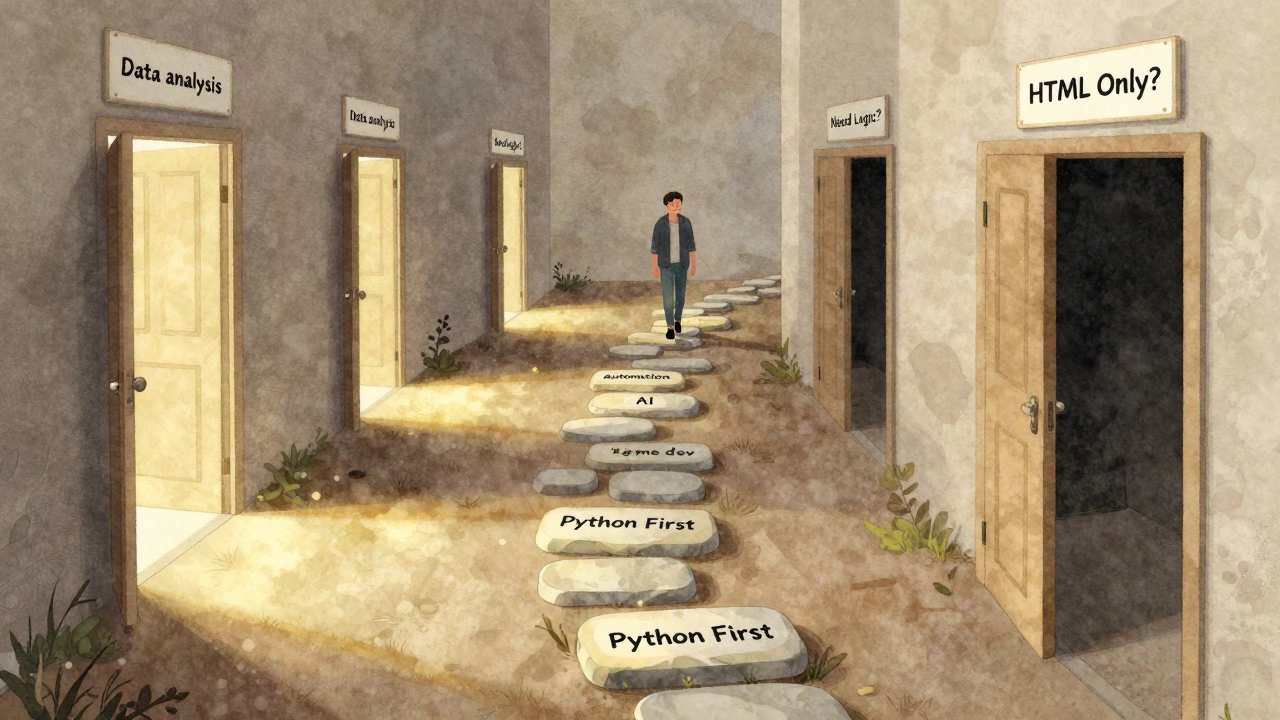
- Start with Python. Spend two weeks building small tools - a to-do list, a password generator, a quiz game.
- Then, learn HTML and CSS. You’ll understand them better because you already know how code works. You’ll see HTML as data, not magic.
- Now, combine them. Build a website that pulls data from a Python script. Maybe a weather dashboard that updates every hour. That’s when it clicks.
This way, you’re not learning two unrelated things. You’re learning one skill - programming - and applying it in two contexts.
What If You’re Not Sure?
Try this: Spend one hour on each.
- Go to replit.com and create a new Python file. Write a program that asks for your name and says “Hello, [name]!”
- Then go to codepen.io and make a webpage with your name in big letters and a background color.
Which one felt more satisfying? Which one made you think, “I could do more with this”? That’s your clue.
If Python made you excited about automation, problem-solving, or logic - go with Python.
If HTML made you excited about design, layout, or visual creativity - go with HTML.
But if you’re still stuck? Start with Python. It opens more doors. Faster.
Final Thought: You’re Not Just Learning a Language - You’re Learning a Way to Solve Problems
Python and HTML aren’t just tools. They’re ways of thinking. Python teaches you how to break down problems into steps. HTML teaches you how to structure information.
Most people who start with HTML end up learning Python anyway - because they realize they need logic. Most people who start with Python end up learning HTML - because they want to show their work to the world.
So if you’re asking, “Should I learn Python or HTML first?” - the answer isn’t about which is better. It’s about which will get you to your goal faster.
For most beginners? Python.
Can I learn Python and HTML at the same time?
Yes, you can - but it’s not recommended for complete beginners. Learning two very different systems at once can cause confusion. HTML is about structure. Python is about logic. Mixing them too early makes it harder to build a strong foundation in either. Start with one, get comfortable, then add the other.
Is HTML still worth learning if I want to be a data scientist?
Not directly. Data scientists use Python to analyze data, build models, and create visualizations. They rarely need HTML. But if you ever want to share your results online - like a dashboard or interactive report - then knowing HTML and CSS helps you present your work. So it’s useful, but not essential early on.
Do I need to learn JavaScript if I start with Python?
Only if you plan to build websites that users interact with directly. Python can handle backend logic (like processing form data), but the front end - buttons, animations, real-time updates - needs JavaScript. If you’re focused on automation, data, or AI, you can skip JavaScript for now. If you want to build apps people use in browsers, you’ll need it later.
How long does it take to get good at Python?
You can write useful Python scripts in under a week if you practice daily. Becoming comfortable enough to solve real problems - like automating reports or analyzing data - usually takes 4 to 8 weeks of consistent practice. Mastery takes years, but you don’t need to be a master to start getting value from it.
What’s the easiest way to start learning Python?
Use a free platform like Replit or Google Colab. No setup required. Start with simple projects: a number guessing game, a calculator, or a to-do list. Focus on making things that solve small problems in your life. That’s how real learning happens - not by watching videos, but by building.
