
MBA Application Strength Estimator
Enter Your Profile Data
Select any that apply to your profile:
Admission Outlook
Enter your details and click analyze to see your estimated competitiveness for different MBA tiers.
Imagine you have a stellar career, five years of management experience, and a burning desire to pivot into finance. Then you look at your undergraduate transcript. Your GPA is a 2.8. Panic sets in. You scroll through the websites of top business schools, seeing average GPAs of 3.7 or higher, and assume your dream is dead before it begins.
Here is the hard truth: there is no single number that universally disqualifies you from an MBA program. However, there are soft ceilings. If your GPA falls below certain thresholds, you need a battle plan, not just hope. This article breaks down exactly where those lines are drawn, how admissions committees actually read your grades, and what you can do right now to offset a lower academic record.
The Hard Numbers: Where Are the Cutoffs?
Admissions officers don't use a cookie-cutter approach, but data reveals clear patterns. We can categorize MBA programs into three tiers based on their typical academic expectations. Understanding which tier you are targeting helps set realistic goals.
| School Tier | Average Class GPA | Minimum Competitive GPA | "Too Low" Threshold |
|---|---|---|---|
| Top 10 Global (e.g., Harvard, Wharton) | 3.7 - 3.9 | 3.5 | Below 3.2 (requires exceptional other metrics) |
| Top 25-50 Regional/National Leaders | 3.4 - 3.6 | 3.0 | Below 2.8 |
| Online/Part-Time/Non-Ranked | 3.0 - 3.3 | 2.5 | Below 2.0 (often requires prerequisite courses) |
If your GPA is above 3.0, you are generally safe from automatic rejection at most accredited schools. The danger zone starts when you drop below 3.0. At this point, your application moves from "standard review" to "holistic scrutiny." Schools will ask: "Why is the GPA low, and does it predict failure in our rigorous curriculum?"
For Executive MBA programs, these numbers shift slightly. Because EMBA candidates typically have 10+ years of senior leadership experience, schools place less weight on undergrad GPAs. A 2.8 might be acceptable if you are a VP-level executive with a strong track record. For traditional full-time MBAs, however, academics still carry significant weight because the cohort needs to maintain a baseline level of analytical rigor.
Context Matters: Why Admissions Committees Care About Trends
A raw GPA number is static, but your academic journey is dynamic. Admissions committees look for context. They want to understand the story behind the grade. A 2.9 GPA looks very different depending on the narrative attached to it.
Consider two candidates:
- Candidate A: Started with a 3.8 freshman year, dropped to a 2.5 sophomore year due to a family health crisis, then rebounded to a 3.7 junior and senior year. Final GPA: 3.0.
- Candidate B: Consistently earned Cs and Bs throughout all four years, with no major life disruptions. Final GPA: 3.0.
Candidate A has a compelling upward trend. It shows resilience and the ability to handle stress while maintaining high performance. Candidate B’s record suggests a lack of engagement or consistent effort. In the eyes of an admissions officer, Candidate A is often the stronger applicant despite having the same final number.
Another critical factor is the difficulty of your undergraduate institution. A 3.0 from a highly competitive engineering school at MIT or Stanford carries more weight than a 3.0 from a university with open admissions policies. Similarly, your major matters. A 2.8 in Chemical Engineering is viewed differently than a 2.8 in a non-quantitative liberal arts major. Business schools know that STEM majors often face steeper grading curves.
The Great Equalizer: Standardized Test Scores
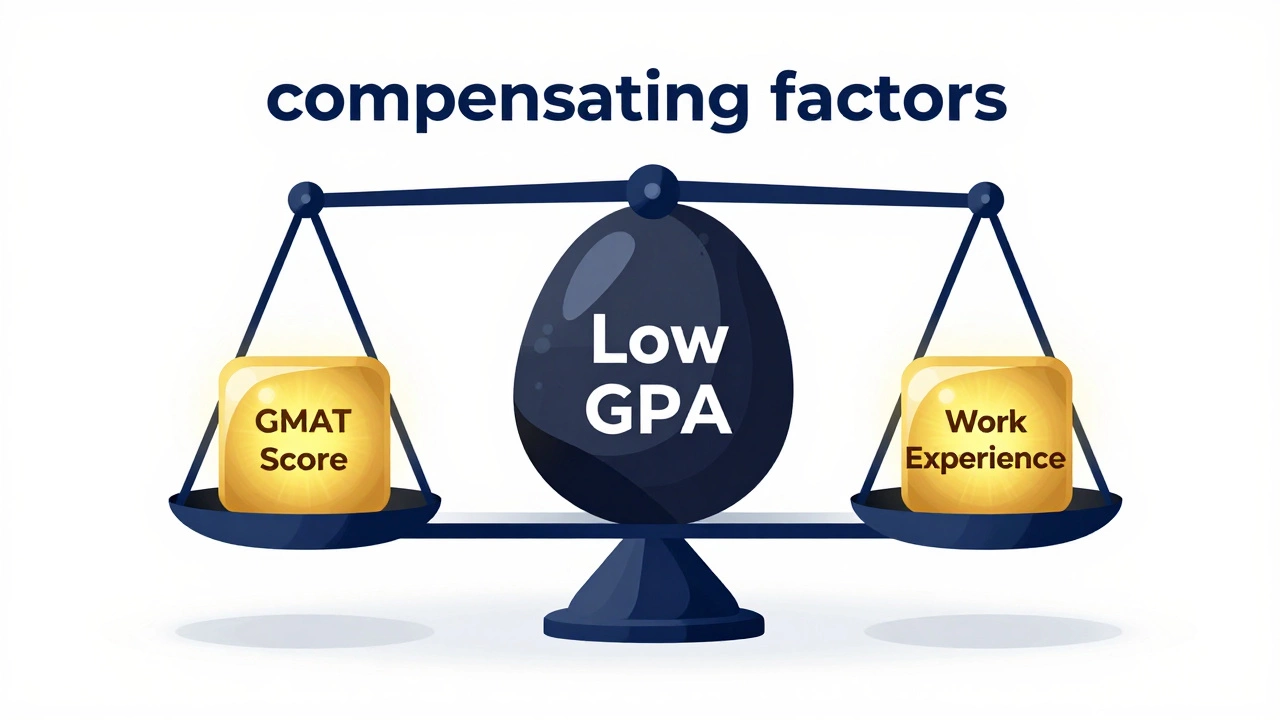
If your GPA is too low, you need to prove your intellectual horsepower elsewhere. This is where the GMAT or GRE becomes your best friend. These tests are standardized, meaning they offer an apples-to-apples comparison across all applicants.
Here is the rule of thumb: If your GPA is below 3.0, you should aim for a test score in the 85th percentile or higher. For the GMAT Focus Edition, this means scoring around 685-700+. For the GRE, this translates to a Quantitative score of 168+ and a Verbal score of 160+.
Why does this work? It signals to the committee that your low GPA was likely due to external factors, poor time management in college, or a mismatch with your undergraduate major-not a lack of cognitive ability. A high test score effectively neutralizes the risk associated with a low GPA.
Don't underestimate the power of the GMAT Focus Edition, launched recently to replace the older GMAT format. Many schools now prefer it because it emphasizes data interpretation and quantitative reasoning-skills directly relevant to modern business analytics. Crushing this exam demonstrates you are ready for the math-heavy core courses like Finance and Operations Management.
Work Experience: Proving You Can Perform
Your professional career is the second pillar of your application. While GPA predicts academic success, work experience predicts professional impact. If you have a low GPA, your resume must scream competence.
Admissions committees look for three things in your work history:
- Progression: Have you moved up the ladder? Promotions indicate that managers trust you with increasing responsibility.
- Quantifiable Impact: Did you increase revenue by 20%? Cut costs by $50,000? Launch a product used by 10,000 users? Specific numbers matter more than job titles.
- Leadership: MBA programs train leaders. Show examples where you led a team, managed a project, or influenced stakeholders without direct authority.
If you have 5-7 years of solid experience at reputable companies, your GPA becomes less critical. Schools are investing in future alumni who will donate, hire interns, and enhance the school's brand. A successful manager with a 2.9 GPA is often more valuable to the ecosystem than a straight-A student with no real-world experience.
Academic Renewal: Showing Current Capability
If your GPA is dragging down your chances, you can actively improve it. This is known as "academic renewal." It involves taking recent, rigorous coursework to demonstrate that you can handle graduate-level academics today.
You have several options:
- Post-Baccalaureate Courses: Take classes at a local community college or university. Focus on quantitative subjects like Calculus, Statistics, or Economics. Aim for As. Even one semester of perfect grades can shift the narrative.
- Online Certifications: Platforms like Coursera or edX offer certificates from top universities. Completing a "Business Analytics" specialization from MIT or a "Financial Markets" course from Yale shows initiative and current knowledge.
- Prerequisite Courses: Some MBA programs allow you to take pre-MBA summer sessions. Excelling here can sometimes waive GPA requirements or significantly boost your candidacy.
This strategy works because it provides fresh data points. An admissions officer sees that while you struggled in college ten years ago, you are currently mastering complex material. It reduces the perceived risk of admitting you.

The Narrative: Using Essays and Recommendations Wisely
Your application essays and letters of recommendation are where you control the narrative. Do not make excuses for your low GPA, but do provide context if there was a legitimate reason.
If you worked full-time while studying, mention it briefly. If you had a medical issue, state it factually. But spend 90% of your essay on your future goals and why you are ready for an MBA now. The goal is to move the conversation away from your past grades and toward your future potential.
Your recommenders play a crucial role here. Choose supervisors who can speak to your analytical abilities and work ethic. A letter that says, "Despite their modest undergraduate grades, [Name] consistently solves complex problems faster than anyone else on my team," is gold. It validates your capability in a professional setting.
When Is It Time to Pivot?
There comes a point where fighting the GPA battle isn't worth the energy. If your GPA is below 2.5, you have a weak GMAT/GRE score, and limited work experience, applying to top-tier programs is likely a waste of application fees.
In this scenario, consider alternative paths:
- Specialized Master's Degrees: Look into Master of Science in Management (MSM), Master of Accounting, or Master of Data Analytics. These programs often have more flexible GPA requirements and can serve as a stepping stone to an MBA later.
- Online MBA Programs: Top schools like Indiana University (Kelley) or University of Illinois (Gies) offer high-quality online MBAs with slightly more accessible admission criteria than their full-time counterparts.
- Deferred Enrollment Programs: Some schools offer deferred entry for current undergraduates. If you are still in school, focus on raising your GPA in your final year.
Remember, an MBA is a tool, not a trophy. The best program for you is the one that aligns with your career goals, budget, and current profile. Don't let a single number define your entire educational journey.
Can I get into a top MBA program with a 2.5 GPA?
It is extremely difficult but not impossible. To be competitive with a 2.5 GPA, you need exceptional compensating factors: a GMAT score above 720, significant leadership experience (10+ years), and perhaps an advanced degree (like a Master's or PhD) with strong grades. You will also need powerful recommendations and a compelling personal story. Most top-tier schools will likely reject such applications unless the rest of the profile is truly outstanding.
Do MBA programs care about my major?
Yes, they do. Admissions committees consider the rigor of your undergraduate major. A lower GPA in a demanding STEM field (Engineering, Physics, Mathematics) is often viewed more favorably than the same GPA in a less quantitative major. This is because STEM curricula typically have stricter grading curves and heavier workloads. Make sure to highlight the difficulty of your coursework in your application.
How much does work experience outweigh GPA?
Work experience can significantly outweigh GPA, especially for candidates with 5-7 years of progressive experience. MBA programs value professional maturity, leadership skills, and real-world problem-solving abilities. If you have a strong track record of promotions and quantifiable achievements, admissions committees may view a lower GPA as a minor flaw rather than a dealbreaker. However, for early-career applicants with less than 3 years of experience, GPA remains a primary screening tool.
Should I retake my GMAT if my first score was low?
Absolutely. If your initial GMAT score is below the median for your target schools, retaking the exam after dedicated preparation is one of the most effective ways to strengthen your application. Most schools only consider your highest score. A significant improvement (e.g., jumping from 600 to 680) demonstrates growth, dedication, and the ability to learn from setbacks-all traits valued in MBA students.
Is an Executive MBA a good option for low-GPA candidates?
Yes, Executive MBA (EMBA) programs are often more flexible regarding undergraduate GPAs. Since EMBAs target senior professionals with extensive experience (usually 10+ years), admissions committees prioritize career achievements and leadership potential over academic transcripts. However, competition for top EMBA programs is fierce, so you still need a strong professional profile and often a decent GMAT/GRE score, though some schools waive this requirement for experienced candidates.
