Find Your Ideal Education Board
Not sure if you're better suited for the conceptual rigor of CBSE, the vast syllabus of ICSE, or the holistic approach of IB? Answer these 5 questions to find out.
Your Recommended Board
Walk into any coaching center in Kota or Delhi during exam season, and you will hear the same debate. Students argue over which curriculum breaks them the most. Is it the Central Board of Secondary Education (CBSE), known for its rigorous science focus? Or is it the Indian Certificate of Secondary Education (ICSE), famous for its vast syllabus and emphasis on literature? The question "what is the hardest board" does not have a single answer because "hard" means different things to different students.
If you are preparing for Class 10 or Class 12 boards, understanding these differences is crucial. It affects how you study, what resources you use, and even your mental health during exam months. This guide breaks down the major education boards in India to help you decide which one fits your learning style and career goals.
The Myth of the "Hardest" Board
Before comparing specific boards, we need to define what makes an exam difficult. Difficulty usually comes from three sources: the volume of content, the depth of conceptual understanding required, and the marking scheme's strictness.
A board might be "hard" because it asks you to memorize thousands of lines of poetry. Another might be "hard" because it requires you to derive complex physics formulas from scratch. A third might feel hard because the grading curve is steep, meaning a small mistake drops your grade significantly. When parents ask about the hardest board, they often mean the one that produces the highest scorers or the one that best prepares students for competitive engineering and medical entrance exams.
CBSE: The Conceptual Challenge
CBSE is the largest board in India, affiliated with thousands of schools across the country and abroad. Its reputation for difficulty stems from its alignment with national competitive exams like JEE (Joint Entrance Examination) and NEET (National Eligibility cum Entrance Test).
The CBSE syllabus is concise but deep. In subjects like Mathematics and Physics, questions rarely test rote memory. Instead, they test application. You cannot simply memorize a formula; you must understand why it works and how to apply it to novel problems. For example, a CBSE Math paper might include a word problem that combines algebra and geometry, requiring multiple steps to solve.
The marking scheme is also strict. Internal assessments count for 20% of your final grade, leaving only 80% for the external board exam. This pressure concentrates all stakes into a few hours of testing. Many students find this stressful because there is little room for error in calculation-heavy subjects.
ICSE: The Volume Monster
ICSE, conducted by the Council for the Indian School Certificate Examinations, takes a different approach to difficulty. Here, the challenge is sheer volume. The ICSE syllabus is notoriously extensive, particularly in English Literature, History, and Geography.
An ICSE student might need to read entire novels, analyze poems line-by-line, and write detailed essays on historical events. The language proficiency required is higher than in most other boards. If you struggle with writing long-form answers or analyzing literary texts, ICSE will feel incredibly hard.
However, ICSE is often praised for building strong communication skills. The depth of study in humanities and languages helps students develop critical thinking and articulation abilities. While CBSE focuses on speed and accuracy in STEM, ICSE focuses on comprehension and expression.
State Boards: The Variable Factor
India has many state boards, such as Maharashtra State Board, Tamil Nadu State Board, and UP Board. Their difficulty levels vary wildly depending on the state’s educational priorities.
Some state boards are considered easier because their syllabi are narrower and their passing criteria are more lenient. Others, like the Kerala State Board or Maharashtra HSC, are highly competitive and academically rigorous. The main issue with state boards is inconsistency. One year’s paper might be easy, while the next year’s could be unexpectedly tough. This unpredictability can make preparation anxiety-inducing for some students.
IB and IGCSE: The International Perspective
For students in international schools, the International Baccalaureate (IB) Diploma Programme and Cambridge IGCSE offer alternative challenges.
The IB Diploma is widely regarded as one of the most demanding secondary curricula globally. It requires students to take six subjects, complete a Theory of Knowledge course, write a 4,000-word Extended Essay, and participate in Creativity, Activity, Service (CAS) projects. The workload is immense, and the assessment style emphasizes independent research and critical analysis over rote learning.
IGCSE, offered by Cambridge Assessment International Education, is flexible but rigorous. It allows students to choose subjects based on interest, but the exams themselves are challenging, especially in sciences and mathematics. IGCSE is often seen as a bridge between Indian boards and Western university systems.
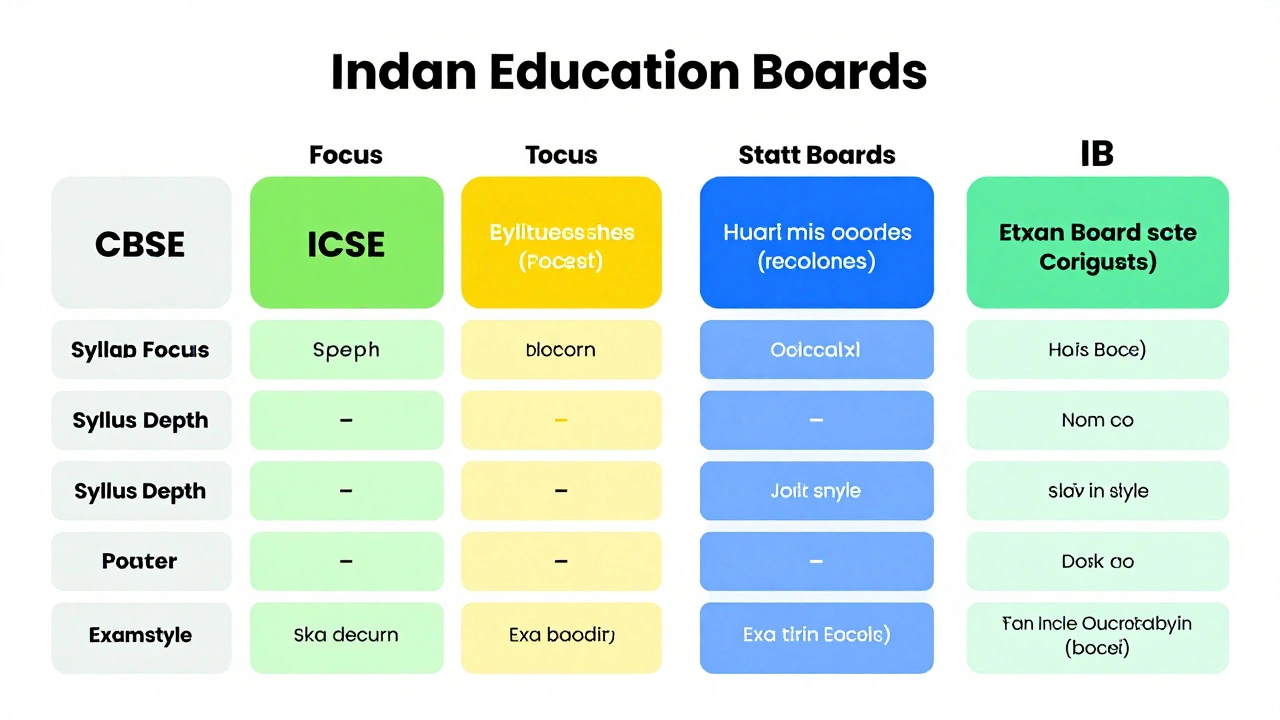
| Board | Primary Focus | Syllabus Depth | Exam Style | Best For |
|---|---|---|---|---|
| CBSE | STEM & Competitive Exams | Deep Concepts | Application-Based | JEE/NEET Aspirants |
| ICSE | Languages & Humanities | Vast Content | Descriptive & Analytical | Arts/Law/Civil Services |
| State Boards | Regional Curriculum | Variable | Mixed | Local University Entry |
| IB | Holistic Development | Extensive Research | Internal + External | Global University Admission |
Why Perception Matters More Than Reality
Often, the "hardest" board is the one that doesn't match your strengths. A student who loves reading and writing will find ICSE manageable but might struggle with CBSE's numerical intensity. Conversely, a math whiz might breeze through CBSE but dread ICSE's essay requirements.
This mismatch creates the perception of difficulty. When a student is forced to study in a way that conflicts with their natural aptitude, every hour feels harder. Therefore, choosing the right board is less about avoiding difficulty and more about aligning with your learning preferences.
Preparing for Any Board: Universal Strategies
Regardless of which board you choose, certain strategies remain effective:
- Consistency Over Cramming: Daily study habits beat last-minute marathons. Review notes daily to keep concepts fresh.
- Past Papers Are Gold: Solving previous years' question papers helps you understand the exam pattern and common traps.
- Active Recall: Instead of re-reading textbooks, test yourself. Close the book and try to explain the concept aloud.
- Time Management: Practice answering questions within time limits. Speed matters in exams like CBSE Math.
- Health First: Sleep and nutrition impact cognitive performance. Burnout is a real risk during board prep.
Final Thoughts on Board Selection
There is no single "hardest" board in India. CBSE demands conceptual clarity and speed. ICSE requires voluminous knowledge and linguistic precision. State boards vary by region. IB expects holistic engagement and independent research. Your goal should be to pick the board that aligns with your career aspirations and learning style. Once chosen, commit to a disciplined preparation plan, and remember that difficulty is often a mindset, not just a metric.
Is CBSE harder than ICSE?
It depends on your strengths. CBSE is harder if you struggle with applying concepts quickly in STEM subjects. ICSE is harder if you find memorizing large volumes of text and writing detailed essays challenging. Neither is objectively superior; they test different skills.
Which board is best for engineering aspirants?
CBSE is generally preferred for engineering aspirants because its syllabus closely aligns with JEE Main and Advanced. The focus on numerical problems and conceptual physics/math helps build a strong foundation for competitive exams.
Are state boards easier than central boards?
Not necessarily. While some state boards have lower passing thresholds, others like Maharashtra HSC or Kerala PUC are highly competitive. The difficulty varies significantly by state and subject. Always check recent year trends for your specific board.
Can I switch boards after Class 10?
Yes, you can switch boards, but it may involve gaps in syllabus coverage. For example, moving from CBSE to ICSE might require extra effort in English literature. Consult your school counselor to ensure a smooth transition and address any missing topics.
How important are internal marks in CBSE?
Internal marks account for 20% of your total score in CBSE. This includes practical exams, project work, and periodic tests. Ignoring internals can hurt your overall percentage, so treat them with the same seriousness as board exams.
