
Online Course Platform Selector
Define Your Learning Goal
Fill out the form to get a personalized recommendation.
Why this fits:
Explanation goes here.
Best For:
Pricing Model:
Credential Value:
Scrolling through course catalogs can feel like walking into a library where every book is written in a different language. You want to learn Python, get certified in project management, or finally master watercolor painting, but the sheer number of platforms makes your head spin. Which one actually delivers quality? Which one won't waste your money? And which certificate will employers actually respect?
The truth is, there isn't one single "best" site for everyone. The right platform depends entirely on what you are trying to achieve. Are you looking for a university-grade degree, a quick weekend hobby tutorial, or a corporate-approved certification? In 2026, the landscape has shifted significantly. AI-driven personalization is standard, and industry-recognized credentials have become more valuable than ever. Let’s break down the top contenders so you can pick the tool that fits your specific goal.
Quick Summary / Key Takeaways
- Coursera is best for academic rigor and university-backed degrees that carry weight on a resume.
- Udemy offers the widest variety of practical, low-cost skills with frequent sales, ideal for self-paced learners.
- LinkedIn Learning excels at soft skills and business topics, integrating directly with your professional profile.
- edX provides high-quality non-profit education from institutions like Harvard and MIT, often for free.
- Pluralsight remains the gold standard for deep-dive technical and IT professional training.
Understanding Your Learning Goal First
Before you spend a dime, you need to define what "success" looks like for this course. This is the most critical step because it dictates which platform architecture suits you. If you need a credential that proves you can do the job, you need an accredited institution. If you just need to know how to fix a leaky faucet or code a basic website, you need practical, hands-on instruction without the fluff.
We can categorize online learning into three main buckets:
- Career Advancement & Credentials: You need a certificate or degree to get promoted, switch careers, or meet compliance requirements. Here, brand recognition matters.
- Skill Acquisition & Practicality: You want to learn a specific tool (like Excel, Photoshop, or React) quickly. Speed and clarity matter more than prestige.
- Personal Interest & Hobbies: You are learning for fun. Flexibility, community, and enjoyment are key.
Mismatching the platform to the goal is the fastest way to quit. Don’t buy a $500 university specialization if you just want to learn how to change a tire. Conversely, don’t rely on a random YouTube tutorial if you are trying to pass a rigorous engineering exam.
Top Platforms for Academic Rigor and Degrees
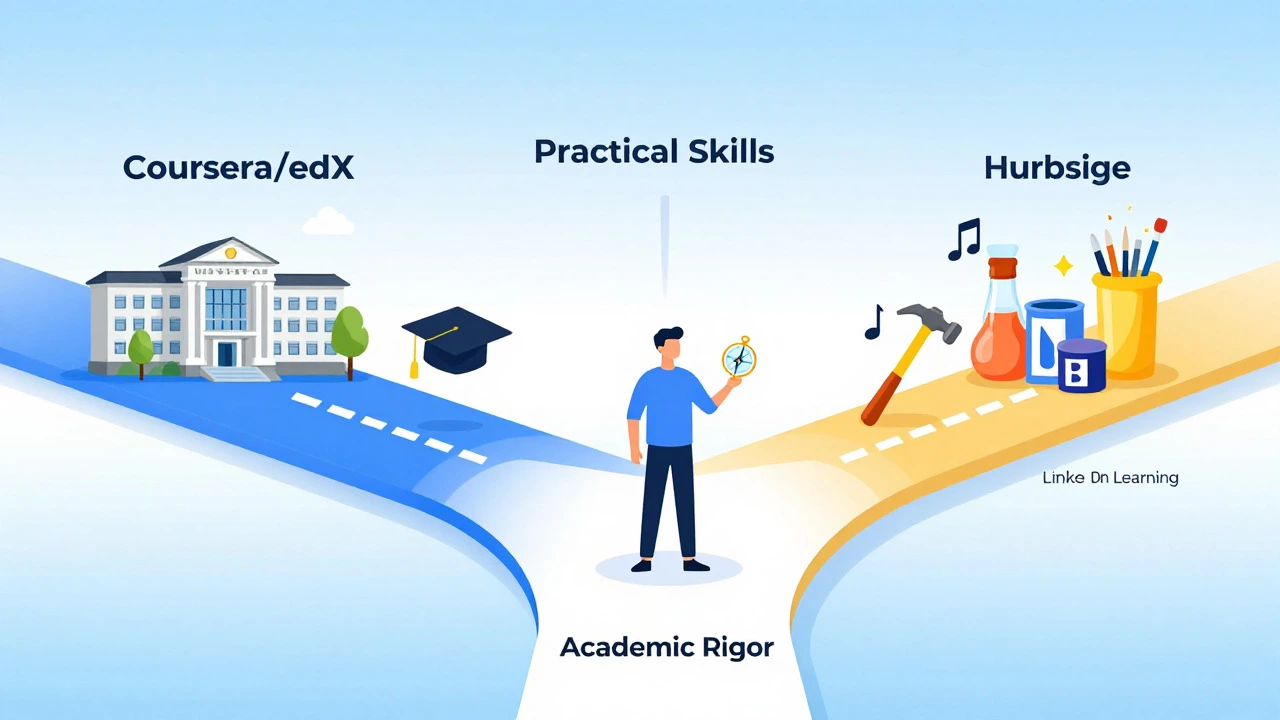
If your goal is career transformation or academic validation, you need platforms that partner with universities. These sites offer structured curricula, peer-reviewed assignments, and certificates that hold weight in HR departments worldwide.
Coursera is the market leader in university-partnered online education. It hosts courses from over 300 leading universities and companies, including Yale, Stanford, and Google. What sets Coursera apart is its "Specializations" model, which bundles multiple courses into a comprehensive program. For example, their IBM Data Science Professional Certificate has helped thousands transition into tech roles without a prior computer science degree. In 2026, Coursera has expanded its AI-driven tutoring features, providing personalized feedback on coding assignments and essays, which bridges the gap between self-study and classroom interaction.
edX is a non-profit online learning platform founded by Harvard University and MIT. Unlike Coursera, edX maintains a strong focus on open educational resources. Many of its core courses are free to audit, meaning you can access lecture videos and readings without paying. You only pay if you want a verified certificate. edX is particularly strong in STEM fields, humanities, and social sciences. Their MicroMasters programs are graduate-level course series that can sometimes count toward credit for full master's degrees at participating universities. This makes edX a powerful entry point for those considering formal higher education but unsure about committing to tuition costs upfront.
Both platforms require significant time commitment. Expect to spend 10-15 hours per week for a typical specialization. The value here is not just the content, but the signal it sends to employers: you completed a rigorous, standardized curriculum from a reputable institution.
Best Platforms for Practical Skills and Budget Learners
Not everyone needs a university stamp. Sometimes you just need to know how to use Salesforce, edit video in Premiere Pro, or manage a small business budget. For these needs, marketplaces like Udemy and Skillshare dominate.
Udemy is an online learning and teaching marketplace with over 213,000 courses and 62 million students. Anyone can create a course on Udemy, which means quality varies wildly. However, the rating system and review comments help filter out the noise. Look for courses with over 4.5 stars and hundreds of recent reviews. Udemy’s pricing model is unique: courses are often listed at $100+, but they go on sale for $10-$15 almost weekly. Never pay full price on Udemy. The platform is excellent for niche technical skills, such as learning a specific version of SAP or mastering advanced Excel macros. Because instructors update their courses frequently to keep up with software changes, you often get more current content than on slower-moving university platforms.
Skillshare is a community-based platform focused on creative and entrepreneurial skills. Instead of long, lecture-style videos, Skillshare uses short, project-based classes. It is ideal for designers, writers, and marketers who learn by doing. The subscription model gives you unlimited access to thousands of classes, encouraging exploration. If you want to learn UI/UX design, illustration, or personal branding, Skillshare’s project feedback loop and active community forums provide motivation that solitary study lacks.
Professional Development and Corporate Training
For professionals already in the workforce, especially in tech and business, learning often needs to be integrated into daily workflows. This is where LinkedIn Learning and Pluralsight shine.
LinkedIn Learning is a subscription service offering video courses taught by industry experts. Its biggest advantage is integration with your LinkedIn profile. When you complete a course, the certificate automatically appears on your profile, signaling activity and skill acquisition to recruiters and network connections. The content is polished, concise, and highly relevant to business trends-leadership, communication, digital marketing, and management. In 2026, LinkedIn Learning has enhanced its AI recommendations, suggesting courses based on job descriptions you view and skills gaps identified in your profile. It is less about deep theoretical knowledge and more about actionable, workplace-ready skills.
Pluralsight is a technology-focused learning platform for IT professionals, developers, and data scientists. Pluralsight does not do general interest courses. It goes deep. Their "Skills IQ" assessments test your current proficiency in technologies like Azure, Kubernetes, or JavaScript, then generate a personalized path to fill those gaps. The content is created by practitioners, not academics, ensuring it reflects real-world enterprise environments. Companies often subscribe to Pluralsight for their teams, making it a common tool for internal upskilling. If you are a developer aiming for cloud certification or a sysadmin managing complex infrastructure, Pluralsight’s structured paths are unmatched.
Comparison of Top Online Learning Platforms
| Platform | Best For | Pricing Model | Credential Value | Content Style |
|---|---|---|---|---|
| Coursera | University degrees, professional certs | Subscription or per-course | High (Academic/Industry) | Structured, academic |
| Udemy | Niche technical skills, hobbies | Pay-per-course (frequent sales) | Low (Skill demonstration) | Practical, instructor-led |
| edX | STEM, humanities, micro-masters | Audit free, pay for cert | High (Academic) | Rigorous, university-style |
| LinkedIn Learning | Business, soft skills, career growth | Monthly subscription | Medium (Profile visibility) | Concise, professional |
| Pluralsight | IT, development, data science | Monthly subscription | High (Technical proficiency) | Deep-dive, assessment-driven |

How to Choose the Right Platform for You
Selecting a platform comes down to answering three questions honestly.
1. What is your timeline? If you need a skill next week, avoid multi-month university specializations. Go with Udemy or LinkedIn Learning for bite-sized, immediate application. If you have six months to a year, commit to a Coursera or edX program for deeper mastery.
2. Who pays? If your employer is covering the cost, check their preferred vendors. Many corporations have bulk licenses for LinkedIn Learning or Pluralsight. Using these ensures your learning aligns with company standards and may even count toward performance reviews. If you are paying out of pocket, calculate the ROI. A $50 Udemy course might save you hiring a consultant for a specific task. A $500 Coursera certificate might lead to a promotion worth $10,000.
3. Do you need accountability? Self-paced learning requires discipline. Platforms like Coursera and edX offer deadlines and peer grading, which create external pressure to finish. Udemy and Skillshare are entirely self-directed; without a schedule, many users start courses and never finish them. If you struggle with procrastination, choose a platform with cohorts or deadlines.
Common Pitfalls to Avoid
Even with the best platform, success isn’t guaranteed. Here are the most common mistakes learners make in 2026.
- Hoarding Certificates: Collecting certificates without applying the skills is useless. Employers care about what you can do, not just what you watched. Build a portfolio alongside your courses. Code projects, design samples, or case studies prove competence better than any badge.
- Ignoring Reviews: On marketplaces like Udemy, always read the 3-star reviews. They often highlight outdated content or poor audio quality, which 5-star reviews ignore. Check the last updated date. A programming course from 2022 might teach deprecated libraries.
- Overloading: Enrolling in five courses at once leads to burnout. Focus on one primary skill at a time. Depth beats breadth when building expertise.
- Skipping Practice: Passive watching is not learning. Pause videos and replicate exercises. If a course doesn’t include hands-on labs or quizzes, supplement it with external practice problems.
Future Trends in Online Learning
The landscape continues to evolve. By late 2026, we are seeing increased integration of AI tutors that adapt to your learning speed in real-time. Blockchain verification of credentials is also becoming more common, allowing you to share tamper-proof proof of your achievements. Additionally, micro-credentials-short, focused certifications in specific tools-are gaining traction over broad degrees in fast-moving industries like tech and digital marketing. Staying flexible and choosing platforms that update their content frequently will keep your skills relevant.
Is Coursera or Udemy better for beginners?
It depends on the subject. For academic subjects or career-changing fields like data science or psychology, Coursera is better due to its structured, university-backed curriculum. For practical, hands-on skills like graphic design, coding basics, or photography, Udemy is often more accessible and affordable, allowing beginners to jump straight into practice without theoretical overload.
Are online certificates worth it in 2026?
Yes, but with caveats. Certificates from recognized platforms like Coursera, edX, or industry-specific bodies (like AWS or Google Cloud) add credibility to your resume. However, they are most effective when combined with practical experience. A certificate opens the door; your portfolio and interview performance get you the job. Generic certificates from unknown providers have little value.
Can I get a full degree online?
Absolutely. Both Coursera and edX partner with universities to offer fully accredited bachelor’s and master’s degrees online. These programs are rigorous, take several years, and cost similar amounts to on-campus degrees. They are ideal for working professionals who need flexibility but require a formal qualification for career advancement.
Which platform is best for learning programming?
For foundational computer science concepts, edX and Coursera offer excellent university courses. For practical, job-ready coding skills, Pluralsight is superior for intermediate to advanced developers. For absolute beginners wanting to build apps quickly, Udemy has many highly-rated bootcamp-style courses. Always choose courses with interactive coding environments to ensure you are writing code, not just watching it.
Do employers verify online course certificates?
Most employers do not rigorously verify every certificate, but they recognize the brands. Seeing "Google Project Management Certificate via Coursera" signals that you completed a vetted program. For technical roles, employers are more likely to test your skills through coding challenges or portfolios than to check a certificate. The value lies in the skill acquisition, not just the paper trail.
